
The short answer
Yes, it’s possible. The main route is the Kāinga Ora First Home Loan, which needs only a 5% deposit. You must earn under $95,000 before tax (single, no dependants) or under $150,000 (two or more buyers, or a single buyer with dependants), be buying your first home to live in, and get a yes from a participating lender. There’s no house price cap. You pay a one-off 1.2% insurance premium, which can be added to the loan. A KiwiSaver first-home withdrawal can make up the deposit if you’ve been a member for at least three years. Some banks also lend with low deposits outside the scheme, usually at a higher rate. Both National and Labour have promised to lift the income cap to $300,000, but nothing changes unless a new government passes it.
Checked 4 November 2026; election details updated 10 November 2026.
01Why this question matters right now
You’re not the only one asking. First-home buyers made up a record 29.5% of all property purchases in the third quarter of 2026. More than half of them borrowed with a deposit of less than 20%, according to the latest Cotality and Westpac report (RNZ, 30 Oct 2026).
Two dates to know:
- Saturday 7 November 2026 was the general election (Electoral Commission), and the First Home Loan income cap was an election promise from both major parties. There is no confirmed new government yet: about 399,000 special votes are still to be counted and final results are due on 27 November (interest.co.nz, 8 Nov 2026).
- Wednesday 9 December 2026 is the next Official Cash Rate decision. The OCR is 2.75%, held on 28 October (RBNZ).
If you’re wondering whether a small deposit rules you out, or you’re new to how mortgages work, this guide is for you.
02How much is 5%, in real numbers?
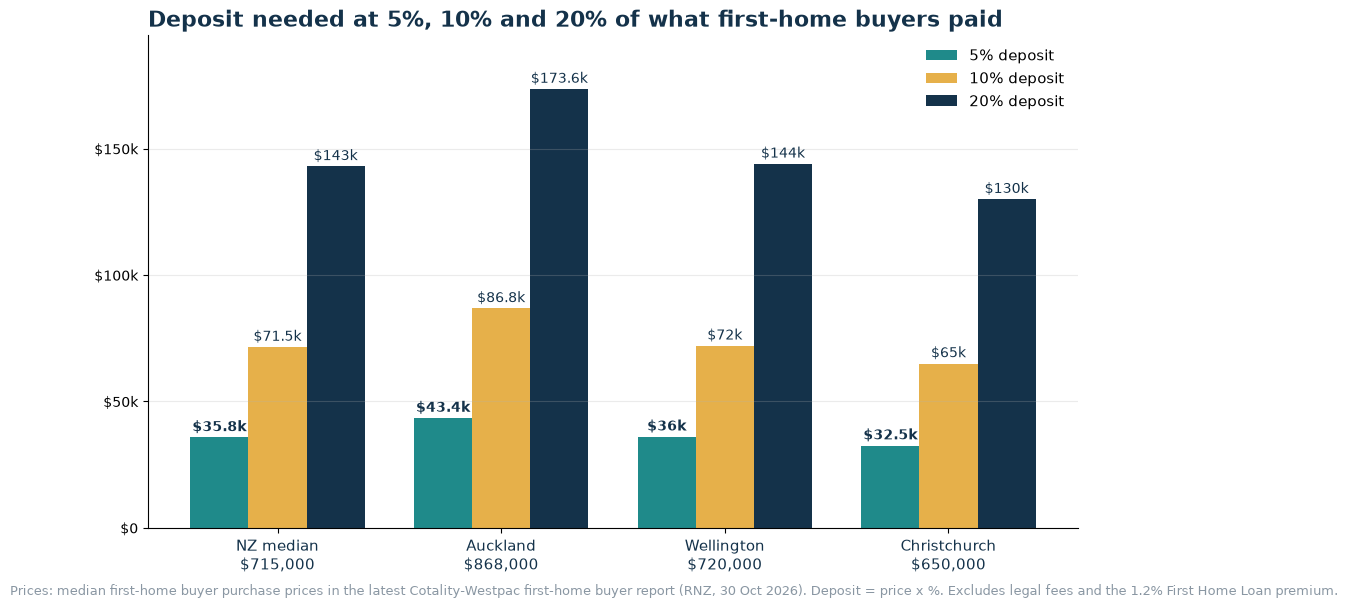
The typical first-home buyer paid about $715,000. The medians were $868,000 in Auckland, $720,000 in Wellington and $650,000 in Christchurch (RNZ).
| Price (first-home buyer median) | 5% deposit | 20% deposit |
|---|---|---|
| NZ $715,000 | $35,750 | $143,000 |
| Auckland $868,000 | $43,400 | $173,600 |
| Wellington $720,000 | $36,000 | $144,000 |
| Christchurch $650,000 | $32,500 | $130,000 |
Alfred arithmetic: price × deposit %. Legal fees, the 1.2% premium and moving costs come on top.
03Route 1: the Kāinga Ora First Home Loan
What it is
A First Home Loan is an ordinary home loan from a bank or other lender. Kāinga Ora underwrites it, which lets the lender accept a 5% deposit when it would normally want 20% (Kāinga Ora). Kāinga Ora doesn’t lend the money. The lender assesses you and makes the final decision.
Who can get one
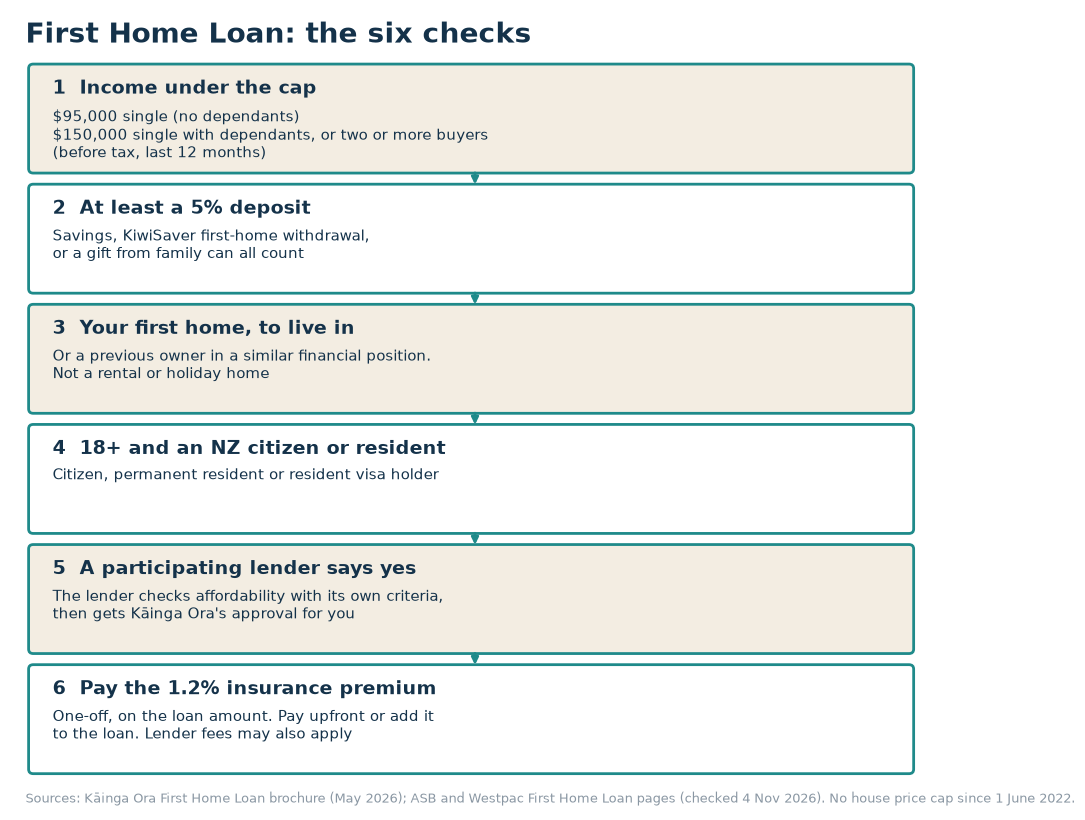
According to Kāinga Ora’s brochure (published May 2026) and the participating banks’ own pages, you need to:
- Earn under the income cap (before tax, over the last 12 months):
- $95,000 for one buyer with no dependants
- $150,000 for one buyer with dependants
- $150,000 combined for two or more buyers
- Have at least a 5% deposit. Savings, a KiwiSaver first-home withdrawal and money gifted by family can all count (Westpac; ASB).
- Be buying your first home to live in. You can’t use it for a rental or holiday home. A previous owner may still qualify if they’re in a similar financial position to a first-home buyer, for example after a separation (ASB).
- Be 18 or over and an NZ citizen, permanent resident or resident visa holder.
- Meet the lender’s own lending criteria. There’s no minimum income, but you have to be able to afford the repayments.
There’s no house price cap. It was removed on 1 June 2022 (Kāinga Ora, Budget 2022). Older articles that quote regional price caps are out of date.
Where to get one
Kāinga Ora’s May 2026 brochure lists these participating lenders: ASB, Westpac, Kiwibank, The Co-operative Bank, SBS Bank, Unity, Nelson Building Society and NZHL. ANZ and BNZ aren’t on that list. Check with the lender, because the list can change.
What it costs: the 1.2% premium
You pay a one-off Lenders Mortgage Insurance premium of 1.2% of the loan amount. You can pay it upfront or add it to the loan. Since 1 July 2025 borrowers have paid the full 1.2%, up from 0.5% when the government paid the rest (Kāinga Ora premium FAQ; RNZ, 7 Sep 2026). Kāinga Ora’s own example: on a $500,000 loan, the premium is $6,000. Lenders may add an application or establishment fee. NBS, for example, lists one “from $450” (NBS).
There is an upside. ASB says a low equity margin doesn’t apply to First Home Loans (ASB). Kiwibank says its special rates are available if you have at least 20% equity or a Kāinga Ora First Home Loan (Kiwibank).
04Route 2: a bank’s own low-deposit loan
If you earn too much for the First Home Loan, or your lender isn’t in the scheme, some banks will still lend with less than 20%. The Reserve Bank lets banks put up to 25% of new owner-occupier lending into loans above 80% LVR (loan-to-value ratio). That setting was kept in August 2026 (RBNZ).
BNZ, for example, advertises its first-home cashback “even with a deposit as low as 5%”, on loans of $250,000 or more, subject to its lending criteria (BNZ). We cover cashback and clawbacks in detail in our mortgage cashback guide.
The catch is cost. Banks charge for low equity in one of two ways:
- A low equity margin added to your rate. Westpac publishes its own: 0.25% a year at 80.01–85% LVR, 0.75% at 85.01–90%, 1.50% at 90.01–95% and 1.75% above 95%. It can be removed once you reach 20% equity and ask for a review (Westpac).
- A higher standard rate instead of the special. Kiwibank offers special rates only with 20% equity or a First Home Loan (Kiwibank). On 4 November 2026, its one-year fixed special was 5.15% and its standard one-year rate 6.05% (interest.co.nz rate table).
The two rules that cap borrowing: LVR and DTI
- LVR limits how much low-deposit lending each bank can do in total.
- DTI (debt-to-income) is the other limit. Banks can lend only 20% of owner-occupier loans to people borrowing more than six times their gross income, minus other debts. The RBNZ’s own example: a household on $120,000 with $20,000 of debt becomes “high-DTI” above $700,000 (RBNZ).
Kāinga Ora loans, including First Home Loans, are exempt from both the LVR and DTI rules (RBNZ LVR; RBNZ DTI). The lender still checks you can afford the repayments.
Car loans, credit card limits and student loans all count as debt in the DTI sum. The RBNZ notes banks look at your card limit, not the balance. That’s why cleaning up debts before you apply can matter.
05Using KiwiSaver as your deposit
For most first-home buyers, the KiwiSaver first-home withdrawal is the deposit. The rules (Inland Revenue; Kāinga Ora):
- You must have been in KiwiSaver for at least three years.
- You can withdraw your contributions, your employer’s, the government contributions and returns, but you must leave $1,000 in. Money transferred from an Australian complying super scheme can’t be withdrawn.
- It’s for a home you’ll live in, not an investment property.
- Couples can each withdraw and pool the money (Kiwibank).
The timing trap
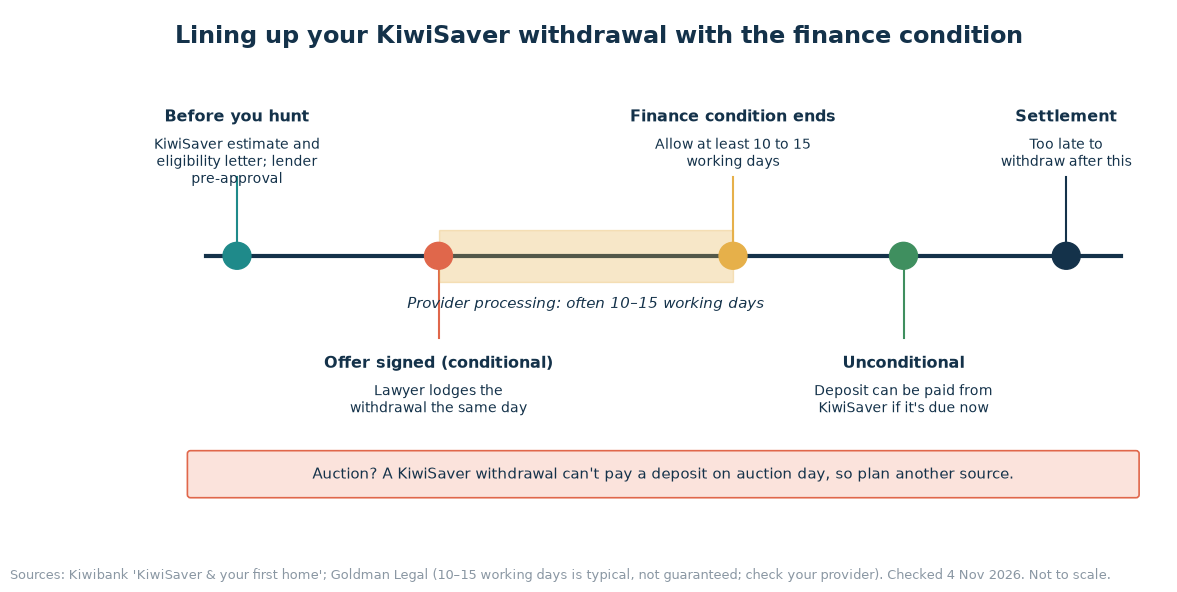
- Get an estimate early. You’ll need your provider’s estimate and an eligibility letter for conditional loan approval (Kiwibank).
- Allow 10 to 15 working days. Most providers take about that long to process a withdrawal, so give your finance condition at least that much time and lodge the application the day you sign (Goldman Legal). Check your own provider’s timeframe.
- Auctions are different. You can’t use a withdrawal for a deposit on a property sold at auction (Kiwibank).
- The money goes to your lawyer, not to you.
- You can’t withdraw after settlement. If the money isn’t through in time, you’ll have to push out settlement or miss out (Kiwibank).
The First Home Grant, which used to top up deposits, closed to new applications on 22 May 2024 (RNZ).
06Worked examples
Example 1: a couple on $120,000 with $40,000 in KiwiSaver
Picture a couple earning $120,000 combined, with $40,000 in KiwiSaver between them, buying at the national first-home median of $715,000.
- Income check: $120,000 is under the $150,000 cap for two buyers. ✔
- Deposit: they must each leave $1,000 in KiwiSaver, so up to $38,000 can come out. 5% of $715,000 is $35,750. That leaves about $2,250 towards legal and other costs, which is tight. ✔
- Loan: $715,000 − $35,750 = $679,250.
- Premium: 1.2% × $679,250 = $8,151. Added to the loan, that makes $687,401.
- Equity on day one: about $27,600, or 3.9% of the price, because the premium is added to what they owe. A small price fall could leave them owing more than the home is worth.
- Repayments: about $866 a week at 5.15%. On the same loan at the 6.05% standard rate, it would be about $956 a week, roughly $90 more.
Their lender still has to be satisfied they can afford it, after car loans, card limits and living costs.
Example 2: one buyer on $110,000, no dependants
Picture one buyer earning $110,000. That’s over the $95,000 single cap, so this person can’t get a First Home Loan under the current rules. Using a bank’s own low-deposit loan on a $600,000 home, Westpac’s published margins would mean, roughly, for the first year:
| Deposit | Loan | LVR | Low equity margin | Extra interest, about |
|---|---|---|---|---|
| 5% ($30,000) | $570,000 | 95% | 1.50% p.a. | $8,550 a year |
| 10% ($60,000) | $540,000 | 90% | 0.75% p.a. | $4,050 a year |
| 20% ($120,000) | $480,000 | 80% | none | $0 |
Alfred arithmetic: loan × margin, ignoring the small drop in balance during the year. For comparison, a one-off 1.2% First Home Loan premium on $570,000 would be $6,840.
The margin keeps applying every year until you reach 20% equity and ask for a review. That is why the First Home Loan’s one-off premium can work out cheaper for people who qualify. Whether a bank will lend at 95% at all is its own decision.
07What the election could change
- National has promised, if re-elected, to raise the income cap to $300,000 for any buyer or group of buyers, single or combined (RNZ, 7 Sep 2026).
- Labour has pledged the same $300,000 household cap. It has also pledged to bring more banks into the scheme and to let eligible working Kāinga Ora tenants build a rent-to-buy deposit (The Post, 29 Oct 2026).
- Both would keep the 5% minimum deposit. As announced, the 1.2% premium and the other settings stay as they are (Staircase).
What it means for you today: nothing yet. The current caps of $95,000 and $150,000 apply until a new government actually changes the scheme, and no start date has been set. If you’re over today’s cap, you can still talk to a lender or adviser about low-deposit options now and check again once any change is confirmed.
08Before you start: a short checklist
- Check your KiwiSaver: three years’ membership, your balance less $1,000, and an estimate from your provider.
- Check the First Home Loan income cap for how you’re buying: alone, as a couple, or with others.
- List every debt and card limit. Each one reduces what you can borrow.
- Get pre-approval before you fall for a house, ideally from more than one lender.
- Set the finance condition to at least 10 to 15 working days, and have a plan for auctions.
- Budget for costs on top of the deposit: legal fees, a building report, the 1.2% premium if you don’t add it to the loan, and moving.
09Where a mortgage adviser fits
You can go straight to a participating bank. An adviser can help if you want several lenders compared at once: First Home Loan lenders and banks’ own low-deposit loans, plus their rates, fees, cashback and criteria. That can help if you have debts, are self-employed, or a bank has already said no. One bank’s no isn’t automatically every bank’s no. The FMA says most mortgage advisers are paid commission by the lender and must tell you upfront how they’re paid (FMA).
10Frequently asked questions
Can I buy a house with a 5% deposit in NZ?
Yes, if you qualify for a Kāinga Ora First Home Loan through a participating lender, or a bank agrees to lend you 95% on its own terms. Either way, the lender must be satisfied you can afford the repayments.
What is the First Home Loan income cap in 2026?
Before tax, over the last 12 months: $95,000 for one buyer with no dependants, and $150,000 for one buyer with dependants or for two or more buyers combined. The $300,000 figure is an election promise, not the current rule.
Is there a house price cap on the First Home Loan?
No. House price caps were removed on 1 June 2022. The lender still decides how much it will lend you.
How much does a First Home Loan cost?
A one-off premium of 1.2% of the loan amount, paid upfront or added to the loan, plus any lender fees. Lenders that don’t apply a low equity margin to First Home Loans, such as ASB, can make the ongoing rate cheaper than a standard low-deposit loan.
Can I use KiwiSaver for my 5% deposit?
Usually, if you’ve been a member for at least three years and are buying a home to live in. You must leave $1,000 in, and you can’t use it for an auction-day deposit.
How long does a KiwiSaver first-home withdrawal take?
Often 10 to 15 working days, according to one law firm’s guidance. Check with your provider and lodge it as soon as you sign.
Do DTI rules apply to First Home Loans?
No. First Home Loans are exempt from the Reserve Bank’s DTI and LVR rules, but the lender still assesses affordability.
11How to use the form
The form is at apply.alfredassistance.com. Most questions are tap-to-choose answers in ranges, not exact figures. The exact questions change with your answers. Here’s what it asks.
- What you’re looking to do. Buy your first home, buy your next home, refix, switch banks, borrow more on your home, or buy an investment property. Pick the one closest to what you want help with.
- Your loan and timing. Whether you already have a mortgage adviser and where the property is. Then, depending on your first answer, things like your timing, roughly how much is left on your mortgage (or how much you’d need to borrow), and who your mortgage is with now.
- You and your finances. Who’ll be on the loan, residency status, household income before tax, how you’re paid, any other debts, and how you’d describe your credit history. The form notes that an honest credit history answer doesn’t affect your credit score.
- Your call. Whether you’re ready to go ahead if the adviser can get it sorted, and what times suit you for a call. There’s also an optional box for anything the adviser should know. Please don’t put account, card or ID numbers in it.
- Your details and a text code. Your first name, last name, email and NZ mobile. You check your answers, tap Text me my code, then type the 6-digit code from the text and tap Confirm and send my enquiry.
What happens after you send it. If we can match your enquiry, it goes to one mortgage adviser in our network, not several, who works under a licensed Financial Advice Provider, and you’ll get a text telling you who it is. They may be based anywhere in New Zealand, not necessarily near you.
It’s free. Alfred never charges you, whether or not we can match your enquiry: adviser firms pay Alfred for introductions. There’s no credit check to enquire.
Start the form →12Sources
All accessed 4 November 2026 (NZDT) unless noted.
- RNZ, What a typical first-home buyer looks like now (30 Oct 2026)
- Electoral Commission, Key dates for 2026 General Election
- interest.co.nz, 8 Nov 2026
- RBNZ, The Official Cash Rate
- Kāinga Ora, First Home Loan (page updated 9 Jul 2026)
- Westpac, First Home Loan (income caps; 1.2% LMI; deposit sources).
- ASB, First Home Loan (income caps; previous owners; 1.2% LMI upfront or added; "A Low Equity Margin does not apply"; exclusions; $5k FHB cash contribution terms).
- Kāinga Ora, Budget 2022 changes
- Kāinga Ora, First Home Loan insurance premium FAQ
- RNZ, Christopher Luxon defends hiking costs for low-deposit home buyers (7 Sep 2026)
- NBS, First Home Loan (loan establishment fee "from $450").
- Kiwibank, Rates & fees
- RBNZ, Reserve Bank maintains LVR settings (14 Aug 2026).
- BNZ, Cash back home loan offer
- Westpac, Low equity margin explained
- interest.co.nz, mortgage rate table (fetched 4 Nov 2026 ~7:05am NZDT)
- RBNZ, Understanding DTI restrictions (last updated 23 Dec 2025)
- RBNZ, LVR restrictions (last updated 19 Dec 2025)
- Inland Revenue, Getting my KiwiSaver savings for my first home
- Kāinga Ora, KiwiSaver first-home withdrawal (updated 23 Apr 2026)
- Kiwibank, KiwiSaver & your first home
- Goldman Legal, Using your KiwiSaver to buy property (Jul 2024)
- RNZ, Government confirms First Home Grants to be scrapped (22 May 2024).
- The Post / Wairarapa Times-Age, First-home buyer battleground (29 Oct 2026)
- Staircase (Kieran Trass), First Home Loan
- FMA, Mortgage advice (page updated 14 May 2026)


