
The short answer
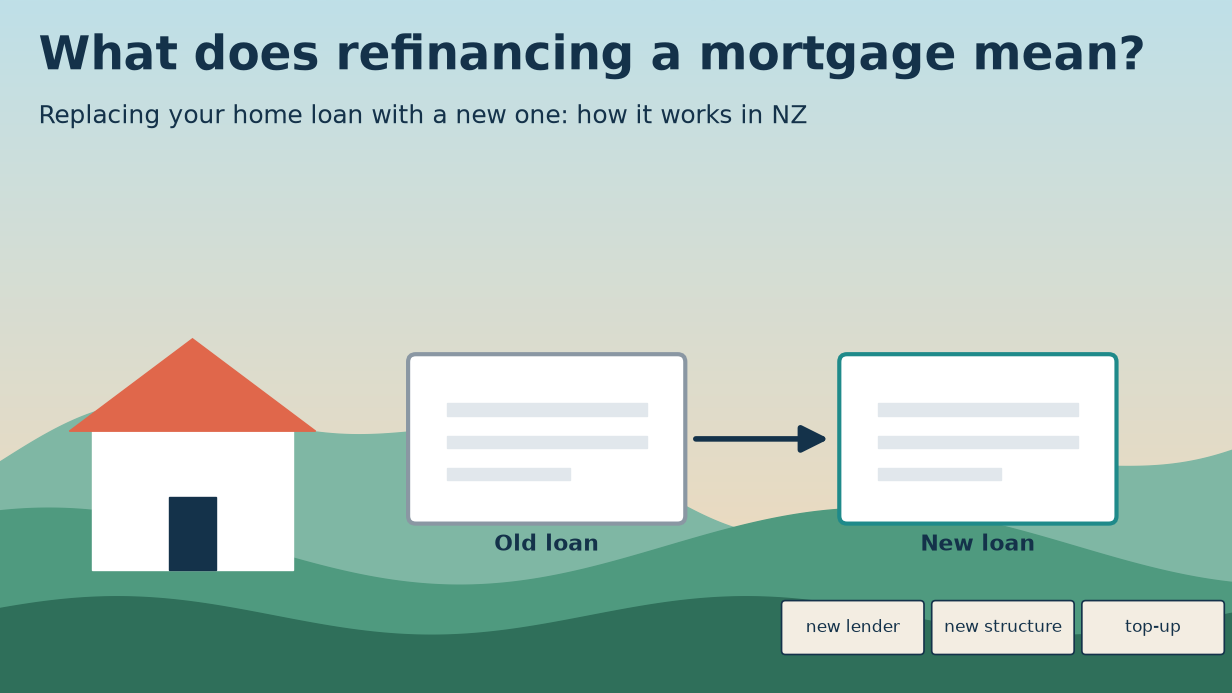
Refinancing a mortgage means replacing your current home loan with a new one. Most often that means moving it to a different lender, which pays off your old loan on settlement day. People also use “refinance” for borrowing more against their home (a top-up) or restructuring the loan with their own bank. It’s different from refixing, which just picks a new fixed rate with the bank you already have. Advisers commonly say a straightforward switch takes around three to six weeks, so if your fixed term is ending, start looking about two to three months before.
Checked 1 November 2026.
01What refinancing means, in plain English
Your mortgage is a loan agreement with a lender, secured over your property. When you refinance, you take out a new loan agreement and use it to repay the old one.
In New Zealand, that usually looks like one of these:
- Moving to a new lender. The new bank lends you the same amount (or more), and on settlement day your old bank is paid out and its mortgage comes off your title. This is what most people mean by “refinancing” or “switching banks”.
- Borrowing more against your home. A top-up uses the equity you’ve built, for a renovation, say, or to buy another property. You can do this with your current bank or as part of a move.
- Rolling other debts into the mortgage. Car loans, credit cards or hire purchase are paid off with mortgage money (debt consolidation).
- Restructuring. Changing the term, the split between fixed and floating, or adding a revolving credit or offset account.
ASB lists much the same reasons on its own switching page: a fixed rate ending, a loan that was “set and forget”, buying, building or renovating, and consolidating debt (ASB).
02Refinancing vs refixing vs topping up
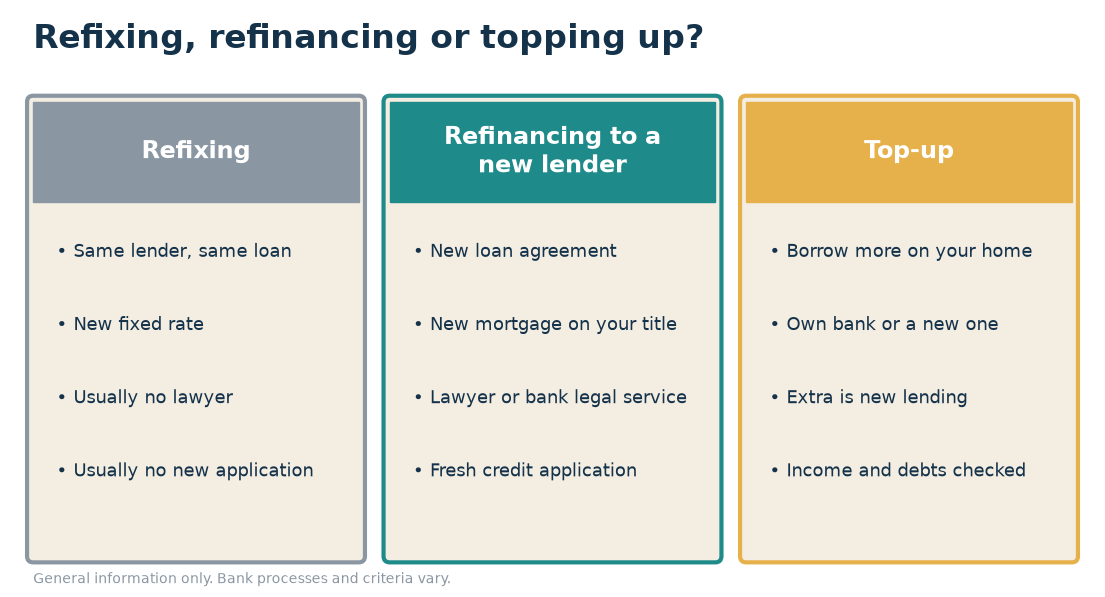
| Refixing | Refinancing to a new lender | Top-up | |
|---|---|---|---|
| Who you borrow from | Same lender | A different lender | Usually the same lender (can be a new one) |
| New loan agreement? | No, a new rate on the existing loan | Yes | Usually a variation or extra loan part |
| Lawyer needed? | Usually not | Usually yes, or the bank’s legal service | Often, if the mortgage documents change |
| Full credit application? | Usually not | Yes | Yes, for the extra amount |
Refixing is the simplest. ANZ, Westpac and BNZ let you lock in a new fixed rate up to 60 days before your current term ends (ANZ, Westpac, BNZ). ASB lets you do it from 35 days before (ASB). If you do nothing, these banks roll your loan onto their floating rate when the fixed term ends.
Refinancing is a bigger job, but it’s the only way to take another lender’s offer. We cover the decision itself in Fixed rate ending soon? What to do next.
03Why people refinance
- A better overall deal. A lower rate, a cash contribution towards switching costs, or both. ASB, for example, says switchers “could get a better interest rate, as well as a cash contribution to help with any switching costs” (ASB). Offers are case by case, so get them in writing.
- A structure that fits now. Life changes: a new baby, a pay rise, a plan to pay the loan off faster. A new structure can matter as much as the rate.
- Using equity. If your home is worth more than when you bought it, you may be able to borrow against that for renovations or another property.
- Consolidating debt. Mortgage rates are usually lower than credit card or car loan rates. But Sorted warns that spreading short-term debt over a 25 or 30-year mortgage means “the total you pay back will be higher”, unless you lift your repayments so the payoff date stays the same (Sorted). Sorted also suggests closing the old cards so the debt doesn’t build up again.
04How refinancing works, step by step
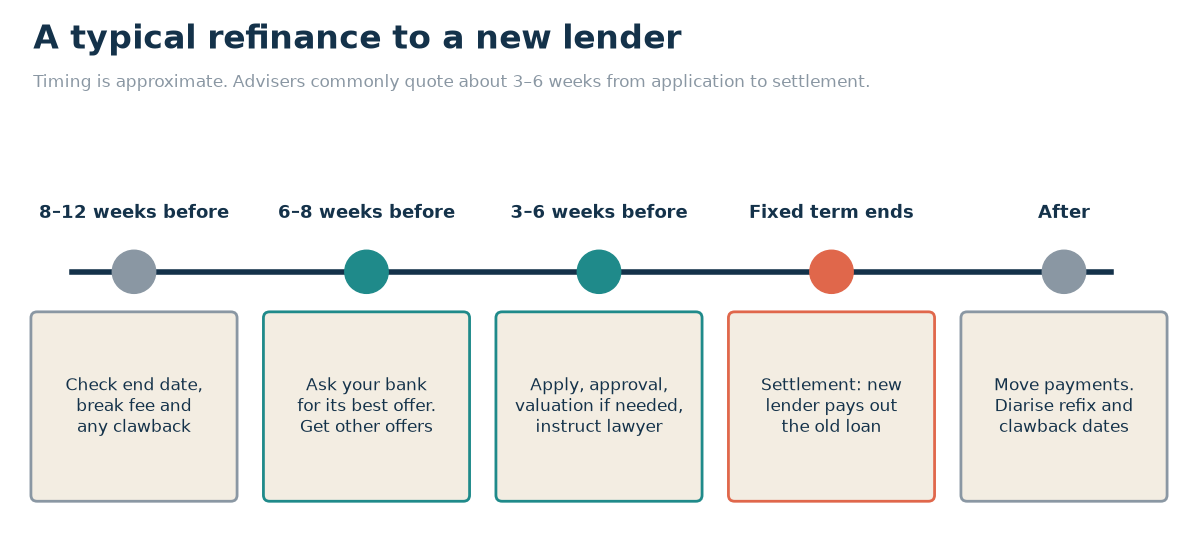
- Check where you stand. Find your fixed-term end date, your loan balance, and whether you’ve had a cash contribution in the last few years that you’d have to repay if you left. If you’re part-way through a fixed term, ask your bank for a written break-fee quote.
- Ask your current bank first. Ask for its best rate and any cash to stay, in writing. Sometimes staying is the right answer, and you only find out by asking.
- Get other offers. Apply to another lender directly, or have a mortgage adviser compare lenders for you. Compare the whole deal: rate, cash, clawback period and who pays the legal costs.
- Apply and get approval. Expect to provide proof of income (payslips, or a profit and loss statement if you’re self-employed), details of your debts and expenses, and ID if you’re new to the bank (ASB). Some lenders need a registered valuation, depending on your equity and the property.
- Legal work. A lawyer discharges the old mortgage and registers the new one on your title. Some banks offer their own legal service to eligible switchers. Kiwibank’s Refinancing Package, for example, includes a free legal transfer service if you meet its criteria, such as a loan of at least $50,000 and 20% equity (Kiwibank).
- Settlement. On the agreed day the new lender pays out the old one. If you’re on a fixed rate, aim to settle on or just after the day your fixed term ends.
- Tidy up. Move automatic payments and direct debits if you’re moving your everyday banking too, check your first repayment date, and note any clawback end date in your calendar.
05How long does refinancing take, and when should you start?
No main bank publishes a standard refinance timeline. Mortgage advisers commonly put a straightforward switch at around three to six weeks from application to settlement, and longer if you’re self-employed, need a registered valuation or have a more complex loan (MoneyBalance, Mortgage Managers).
So if you’re asking “when should I start looking for a new mortgage deal?”, a sensible answer is about two to three months before your fixed term ends. That leaves time to ask your bank, compare offers and get through approval and legal work without rushing. It also lines up with the refix windows: if you decide to stay, ANZ, Westpac and BNZ let you lock a rate 60 days out, and ASB 35 days out.
Starting early matters more when rates are uncertain. The Reserve Bank held the Official Cash Rate (OCR) at 2.75% on 28 October 2026, in a 4–3 vote, and the committee agreed “tighter monetary policy is likely to be required but remains conditional on the economic outlook” (RBNZ). Nobody can tell you where rates go next. What you can control is giving yourself time to compare.
06Is it worth refinancing?
It depends on your numbers. Refinancing tends to stack up when the gain clearly beats the cost of moving. The main costs are:
- Legal fees, unless the new bank covers them.
- Your old bank’s discharge fee.
- A break fee if you leave a fixed rate early. At the end of a fixed term there usually isn’t one.
- Clawback of any cash contribution you received in the last few years.
We’ve worked through these costs with examples in Is it worth switching banks for a better mortgage rate?. The short version: do the whole sum over the years you expect to keep the loan, not just year one. And if your current bank is nearly as good, staying is a perfectly reasonable choice.
07Do the lending rules apply when you refinance?
A like-for-like refinance: the Reserve Bank’s loan-to-value ratio (LVR) restrictions don’t apply to “refinancing a mortgage, where the new loan value doesn’t exceed the original loan value” (RBNZ, LVR). The debt-to-income (DTI) rules have the same exemption (RBNZ, DTI).
Borrowing more: a top-up is new lending. The RBNZ says a change to LVR settings affects existing borrowers who take a top-up “that takes the total LVR above the required threshold”, and its DTI explainer works through a top-up for a home extension as new borrowing (RBNZ, DTI).
Either way, banks “will still apply their own lending criteria” (RBNZ), and they must make reasonable inquiries to be satisfied you can afford the loan (FMA). So a new lender will look at your income, expenses and debts again, even if your loan amount isn’t changing.
08Frequently asked questions
Is refinancing the same as switching banks?
Usually, yes. Most people use “refinancing” to mean moving the loan to a new lender. It can also mean a top-up or restructure with your own bank.
Is refixing a form of refinancing?
Not really. Refixing chooses a new fixed rate on your existing loan with the same bank. There’s usually no new application or lawyer.
Can I refinance before my fixed term ends?
Yes, but you’ll usually pay a break fee if wholesale rates have fallen since you fixed. Ask your bank for a written quote and compare it with what you’d gain.
Does refinancing affect my credit score?
It can. When you apply, lenders check your credit report, and “recent applications for credit” are one of the things they look at. Consumer Protection suggests you “only apply for credit when you need it, as each application may lower your score” (Consumer Protection). So pick your shortlist before you apply, rather than applying everywhere at once.
Do I need a mortgage adviser to refinance?
No. You can apply to another bank yourself. An adviser can help most when you want several lenders compared, the cash and clawback maths done, or the loan restructured as part of the move. Most advisers are paid by the lender, and they must tell you upfront how they’re paid (FMA).
09How to use the form
The form is at apply.alfredassistance.com. Most questions are tap-to-choose answers in ranges, not exact figures. The exact questions change with your answers. Here’s what it asks.
- What you’re looking to do. Buy your first home, buy your next home, refix, switch banks, borrow more on your home, or buy an investment property. Pick the one closest to what you want help with.
- Your loan and timing. Whether you already have a mortgage adviser and where the property is. Then, depending on your first answer, things like your timing, roughly how much is left on your mortgage (or how much you’d need to borrow), and who your mortgage is with now.
- You and your finances. Who’ll be on the loan, residency status, household income before tax, how you’re paid, any other debts, and how you’d describe your credit history. The form notes that an honest credit history answer doesn’t affect your credit score.
- Your call. Whether you’re ready to go ahead if the adviser can get it sorted, and what times suit you for a call. There’s also an optional box for anything the adviser should know. Please don’t put account, card or ID numbers in it.
- Your details and a text code. Your first name, last name, email and NZ mobile. You check your answers, tap Text me my code, then type the 6-digit code from the text and tap Confirm and send my enquiry.
What happens after you send it. If we can match your enquiry, it goes to one mortgage adviser in our network, not several, who works under a licensed Financial Advice Provider, and you’ll get a text telling you who it is. They may be based anywhere in New Zealand, not necessarily near you.
It’s free. Alfred never charges you, whether or not we can match your enquiry: adviser firms pay Alfred for introductions. There’s no credit check to enquire.
Start the form →10Sources
All accessed 1 November 2026 (NZDT) unless noted.
- ASB, Move your home loan to ASB
- ANZ, When the fixed rate on my home loans ends
- Westpac NZ, Fix or refix a new rate
- BNZ, Re-fixing your loan
- ASB Help, When can I change the interest rate on my loan if I have a fixed interest rate?
- Sorted (Te Ara Ahunga Ora), Pros and cons of debt consolidation
- Kiwibank, Switching to Kiwibank
- MoneyBalance, Switching mortgage lenders NZ (adviser/comparison site)
- Mortgage Managers, Refinancing a home loan (adviser firm)
- RBNZ, "OCR held at 2.75%" (28 Oct 2026, updated 29 Oct)
- RBNZ, Loan-to-value ratio restrictions (updated 19 Dec 2025)
- RBNZ, Understanding DTI restrictions (updated 23 Dec 2025)
- FMA, Assessing for affordability
- Consumer Protection (MBIE), Credit checks, scores and history
- FMA, Mortgage advice


