
The short answer
For an existing investment property, banks generally want about a 30% deposit. That comes from the Reserve Bank rule that only 10% of a bank’s new investor lending can sit above 70% LVR (loan-to-value ratio). For a new build bought from the developer within 6 months of completion, the LVR (and DTI) speed limits don’t apply, and banks often lend with about a 20% deposit — still subject to their own criteria. You don’t always need the deposit in cash. Usable equity in your own home can fund it: (home value × 80%) − home mortgage. Example: a $900,000 home with a $500,000 mortgage gives about $220,000 usable — roughly a 30% deposit on a $733,000 existing purchase, or 20% on a $1.1 million new build (Alfred arithmetic). DTI, servicing and weekly cash-flow still cap you even when the deposit stacks up.
Checked 7 November 2026; election details updated 10 November 2026.
01Why this question matters right now
If you’ve been wondering whether you can borrow against your home for a deposit, or whether the ads that make it sound easy are missing some catches, this guide is for you.
Two bits of context, neither of them a reason to rush:
- Investor lending is quieter. New mortgage lending to investors fell from $1,735 million in September 2025 to $1,335 million in September 2026 — down about 23%, the steepest drop of any borrower group (RBNZ data via b2bnews, 30 Oct 2026). Fewer investors competing doesn’t make a purchase a good one. It just means the field is thinner.
- The OCR is 2.75%, held on 28 October. The next decision is Wednesday 9 December 2026 (RBNZ). The general election was on 7 November, and there is no confirmed new government yet: final results are due on 27 November (interest.co.nz, 8 Nov 2026). Nothing about tax or tenancy settings changes until a new government actually legislates.
This guide is about the deposit: how much banks typically want, how equity can stand in for cash, and the other rules that still stop a purchase even when the deposit looks fine.
02What “30% deposit” really means
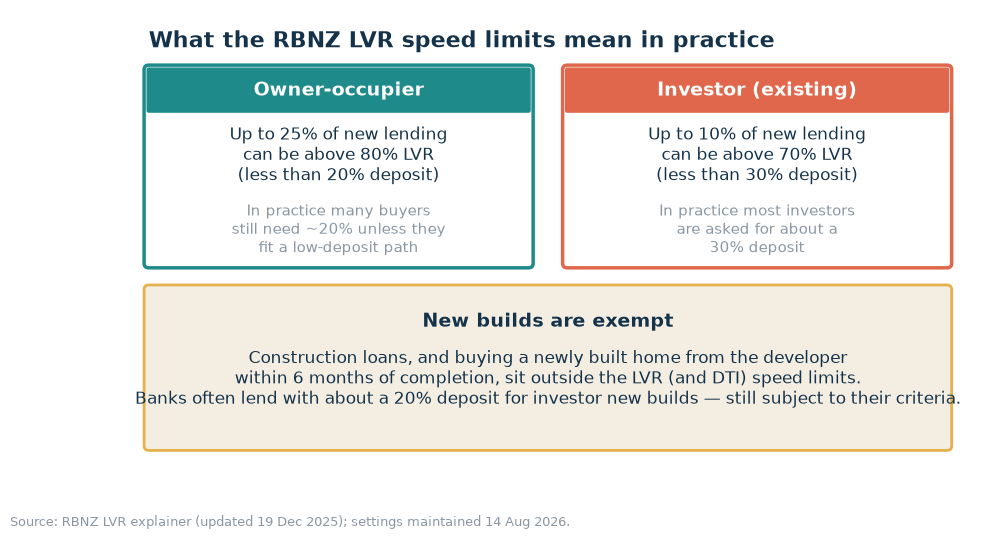
The Reserve Bank doesn’t ban loans above 70% LVR for investors. It sets a speed limit on each bank:
- Investors: up to 10% of new investor lending can be above 70% LVR (less than a 30% deposit).
- Owner-occupiers: up to 25% of new lending can be above 80% LVR (less than a 20% deposit).
Those settings were maintained on 14 August 2026 (RBNZ media release; RBNZ LVR explainer).
In practice, banks ration the small high-LVR share. For most investors buying an existing property, that looks like a ~30% deposit. ANZ puts it plainly: when buying an investment property you generally need a 30% deposit, which can be less for a new build (ANZ). Some advisers report occasional room above 70% LVR where surplus income is strong (mortgages.co.nz / Tony Alexander survey, Sep 2026).
So “30%” is bank practice under a speed limit, not a law that every individual loan must meet.
03Existing property vs new build deposit
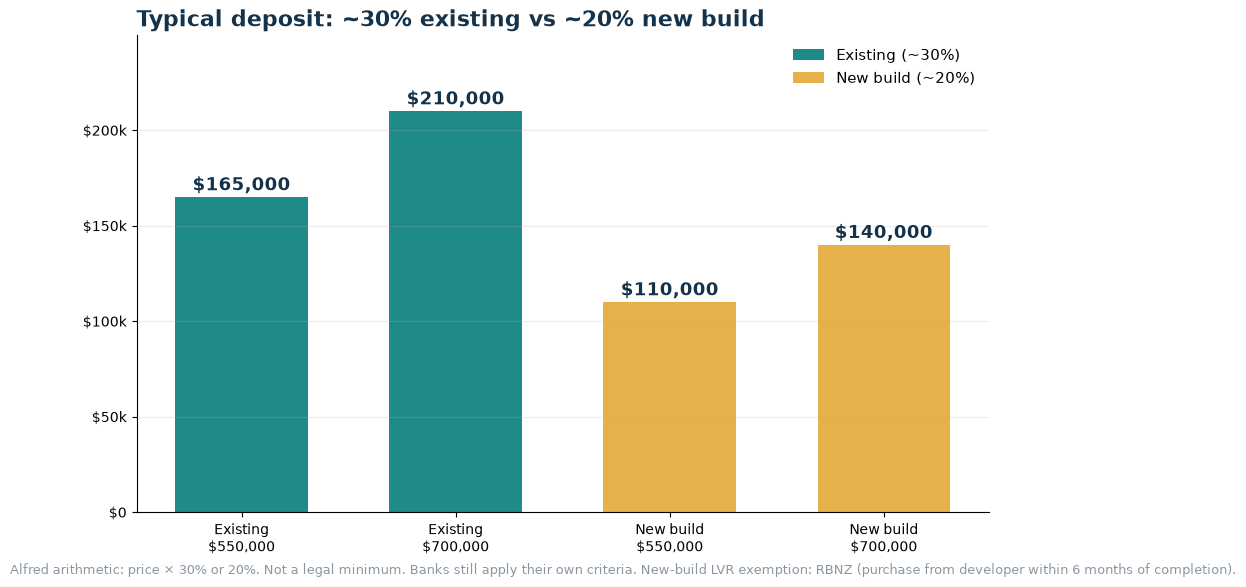
| Property type | Typical deposit banks look for | On a $550,000 purchase | On a $700,000 purchase |
|---|---|---|---|
| Existing investment | about 30% | $165,000 | $210,000 |
| New build (from developer within 6 months of completion) | about 20% | $110,000 | $140,000 |
Alfred arithmetic: price × 30% or 20%. Legal fees, valuations and setup costs come on top.
Why new builds are different: construction loans, and buying a newly built home from the developer within 6 months of completion, are exempt from the LVR and DTI speed limits (RBNZ LVR explainer; RBNZ DTI explainer). Banks still run their own lending criteria. Many will lend to investors with about a 20% deposit on a qualifying new build (Opes Partners; ANZ). An extension or renovation of an existing house does not get the exemption.
04Using equity from your home
You don’t have to save the whole deposit in cash. If you already own a home, usable equity can be the deposit.
The formula
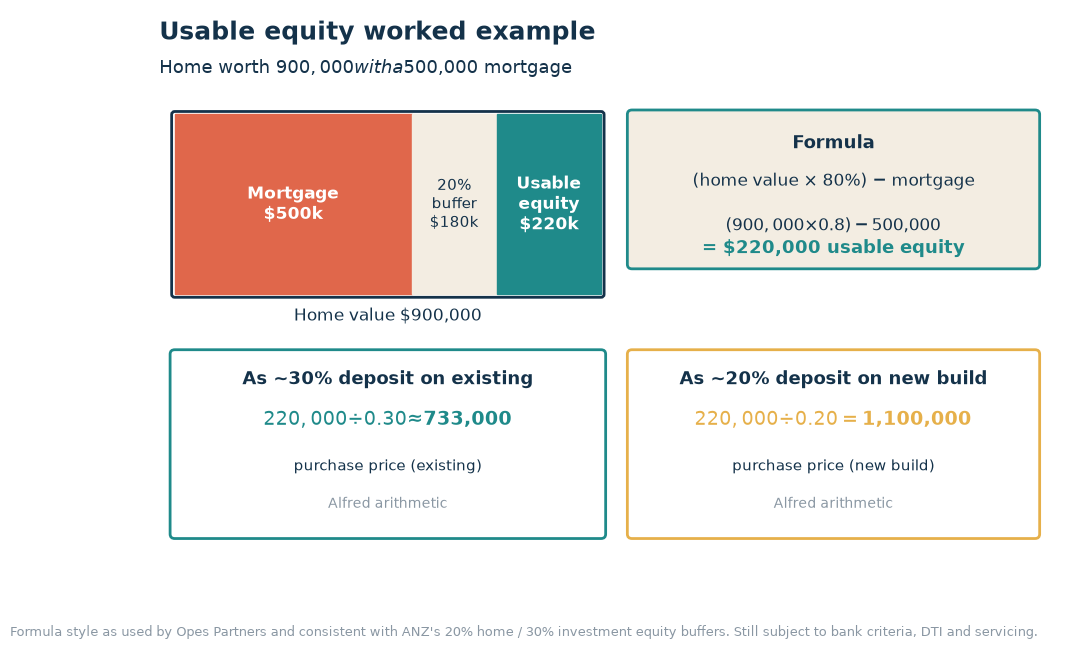
Usable equity ≈ (home value × 80%) − home mortgage
Banks generally want you to keep at least about 20% equity in your home and about 30% in investment properties (ANZ; Opes Partners). The 80% in the formula is that home buffer.
Worked numbers
Picture a home worth $900,000 with a $500,000 mortgage:
- Maximum against the home at 80%: $900,000 × 0.8 = $720,000
- Minus the existing mortgage: $720,000 − $500,000 = $220,000 usable equity
- As a ~30% deposit on an existing rental: $220,000 ÷ 0.30 ≈ $733,000 purchase price
- As a ~20% deposit on a new build: $220,000 ÷ 0.20 = $1,100,000 purchase price
Alfred arithmetic. Still subject to DTI, servicing, valuation and the bank’s own criteria. A current valuation matters — what you paid years ago doesn’t.
Split banks vs cross-collateral
A common question is whether you can borrow against your home at one bank, use it as a deposit with another, and whether your bank will mind.
ANZ’s own guidance: you don’t necessarily have to take the new loan with the bank that holds your existing property. You can borrow against equity at one bank and buy with another (ANZ).
Two common structures:
- Cross-collateralised (one bank): the bank takes security over both properties. Simpler day-to-day. Harder if you later sell one property and want to keep the proceeds, because the bank can reassess the whole picture.
- Split banks: equity release from one lender, purchase loan with another. More moving parts. Can make it easier to sell a rental later without the family home being dragged into the same settlement.
Neither structure is automatically “safer”. Using equity means more debt against your home. ANZ notes you need to be comfortable managing that debt if values fall or rates rise (ANZ). Fear of putting the family home at risk is a real one — structure it deliberately, don’t rush it.
05DTI and servicing still cap you
A deposit only answers “how much equity”. DTI and the bank’s servicing test answer “how much debt can you carry”.
For investors, borrowing is high-DTI above 7× gross (before-tax) income, after existing debt. Banks can put up to 20% of new investor lending into high-DTI loans (RBNZ DTI explainer). Credit card limits count as debt, not just the balance. Car loans and student loans count too. Rental income can count toward income, usually after the bank discounts it.
The Reserve Bank’s own investor example: Priyanka is assessed at $85,000 wages plus $380/week expected rent ($104,760 total income), with a $190,000 home mortgage. Before she counts as high-DTI she can borrow up to:
7 × $104,760 − $190,000 = $543,320
New builds that qualify for the construction / near-new exemption sit outside the DTI speed limit as well as LVR — but the bank still checks you can afford the repayments.
06Cash-flow reality: the weekly top-up
Even with the deposit sorted, rent often doesn’t cover every cost when you borrow most of the price. Opes Partners, citing Valocity, says about 90% of investment properties were negatively geared in 2024, and in August 2026 a typical top-up sat roughly between $200 and $400 a week when you borrow the lot (Opes Partners, 1 Sep 2026). Their worked examples at a 5% interest rate, borrowing 100% of the price, showed shortfalls of about $240–$309 a week depending on the city and property.
Rates, rents, rates (council), insurance and vacancy all move. A practical check some advisers suggest: bank the expected top-up for two or three months before you commit, and see whether your household budget holds (Opes Partners).
07Worked examples
Example 1: equity-funded existing rental
A couple own a $900,000 home with a $500,000 mortgage. Usable equity ≈ $220,000 (Alfred arithmetic, as above). They look at an existing rental at $700,000.
- 30% deposit needed: $210,000
- Usable equity covers it, with about $10,000 left toward costs
- Loan on the rental: about $490,000
- Their home loan may rise if the deposit is released as a top-up against the home — total debt goes up either way
- They still need enough income and DTI headroom for the combined debt
Example 2: same equity, new-build path
Same couple, same $220,000 usable equity, looking at a $700,000 new build from a developer within 6 months of completion.
- 20% deposit: $140,000
- Usable equity covers it, with about $80,000 spare (which might stay unused, go to costs, or support a different purchase size)
- Loan on the new build: about $560,000
- LVR/DTI speed limits don’t apply to a qualifying new build, but the bank’s own criteria and affordability test still do
Example 3: deposit in cash, DTI is the wall
Someone with $180,000 cash (enough for 30% of a $600,000 existing rental) earns $95,000, has a $350,000 home mortgage and $15,000 of card limits.
- High-DTI threshold (investor): 7 × $95,000 − ($350,000 + $15,000) = $300,000 of new borrowing before it counts as high-DTI (Alfred arithmetic on the RBNZ formula)
- The rental loan they want is $420,000 — above that line
- The deposit is fine. The DTI stack may not be. A bank can place some files in its 20% high-DTI allowance; it doesn’t have to.
08Myths and FAQs
Do I need 30% / $200k sitting in cash?
Not necessarily. Usable equity in your home can be the deposit, and qualifying new builds often need about 20% (ANZ; Opes Partners).
Is 30% the law?
No. It’s what most banks ask for under the RBNZ’s 10% speed limit on investor loans above 70% LVR (RBNZ). Some high-LVR investor lending still happens.
Can I use KiwiSaver for a rental?
No. A KiwiSaver first-home withdrawal is for a home you’ll live in as your principal place of residence (IRD; ASB).
Will my bank mind if I borrow the deposit elsewhere?
It’s your choice where you borrow. ANZ says you don’t necessarily have to take your new loan with the bank that holds your existing property (ANZ). Your current bank still has to approve any top-up or equity release against your home.
Can I claim mortgage interest on a rental?
From 1 April 2025 you can claim 100% of interest on funds borrowed for a residential rental, subject to the usual deductibility rules (IRD). Ring-fencing still stops excess rental losses offsetting your salary (IRD). Bright-line is 2 years for sales on or after 1 July 2024 (IRD).
Will the rent cover everything?
Often not, if you borrow most of the price. Plan for a weekly top-up and stress-test higher rates (Opes Partners; ANZ).
09How to use the form
The form is at apply.alfredassistance.com. Most questions are tap-to-choose answers in ranges, not exact figures. The exact questions change with your answers. Here’s what it asks.
- What you’re looking to do. Buy your first home, buy your next home, refix, switch banks, borrow more on your home, or buy an investment property. Pick the one closest to what you want help with.
- Your loan and timing. Whether you already have a mortgage adviser and where the property is. Then, depending on your first answer, things like your timing, roughly how much is left on your mortgage (or how much you’d need to borrow), and who your mortgage is with now.
- You and your finances. Who’ll be on the loan, residency status, household income before tax, how you’re paid, any other debts, and how you’d describe your credit history. The form notes that an honest credit history answer doesn’t affect your credit score.
- Your call. Whether you’re ready to go ahead if the adviser can get it sorted, and what times suit you for a call. There’s also an optional box for anything the adviser should know. Please don’t put account, card or ID numbers in it.
- Your details and a text code. Your first name, last name, email and NZ mobile. You check your answers, tap Text me my code, then type the 6-digit code from the text and tap Confirm and send my enquiry.
What happens after you send it. If we can match your enquiry, it goes to one mortgage adviser in our network, not several, who works under a licensed Financial Advice Provider, and you’ll get a text telling you who it is. They may be based anywhere in New Zealand, not necessarily near you.
It’s free. Alfred never charges you, whether or not we can match your enquiry: adviser firms pay Alfred for introductions. There’s no credit check to enquire.
Start the form →10Sources
All accessed 7 November 2026 (NZDT) unless noted.
- b2bnews, First-home buyers hit record 29.5% as investors retreat (30 Oct 2026)
- RBNZ, The Official Cash Rate
- interest.co.nz, 8 Nov 2026
- RBNZ, Reserve Bank maintains Loan-to-Value Ratio (LVR) settings (14 Aug 2026)
- RBNZ, Understanding loan-to-value restrictions (last updated 19 Dec 2025)
- ANZ, Borrowing for an investment property
- mortgages.co.nz & Tony Alexander Mortgage Advisers Survey (Sep 2026)
- RBNZ, Understanding debt-to-income (DTI) restrictions (last updated 23 Dec 2025)
- Opes Partners, Can I afford an investment property? (1 Sep 2026)
- IRD, Getting my KiwiSaver savings for my first home
- ASB Help, Can I use my KiwiSaver savings to buy an investment property?
- IRD, Residential property interest limitation rules
- IRD, Residential rental property deductions (ring-fencing)
- IRD, Bright-line test / property rules


