
The short answer
Often, yes. A car loan, a credit card or a past slip-up on your credit file doesn’t automatically rule you out of a home loan in New Zealand. What matters is how much those debts cut into what you can borrow, and how recent and serious any credit problems are. Lenders add up your debts (card limits count, not just balances) under the Reserve Bank’s debt-to-income rule, test whether you can afford repayments at a higher “test” rate, and read your credit report. Defaults can be reported for five years, even once paid (Credit Reporting Privacy Code). The good news: a lot of what lenders look at is fixable, sometimes within weeks.
01Why this question comes up so much
If you’ve got a car loan, a couple of cards or an old default and you’re wondering whether you’re “allowed” to buy, you’re far from alone. Plenty of first-home buyers carry some consumer debt, and a common worry is simple: “I’ll be declined.”
The market right now makes it worth getting this right before you apply:
- People are shopping hard, but fewer loans are getting approved. Mortgage enquiries were up 14.4% on a year earlier, while approved new mortgages were 16% lower in the September 2026 quarter (Centrix October 2026 Credit Indicator).
- The pressure is in unsecured debt. In September, personal loan arrears were 8.8%, buy now pay later (BNPL) arrears 7.1%, car loan arrears 5.2% and credit card arrears 3.9%, against 1.19% for mortgages (Centrix). Lenders notice.
- Advisers say debt alone isn’t the deal-breaker. Mortgage adviser Jeremy Andrews told NZ Adviser that credit cards or personal loans “aren’t a deal breaker in themselves”, but large balances relative to income or deposit “can cut borrowing power significantly” (NZ Adviser, 11 Nov 2026).
02What lenders actually look at
Every bank has its own policy, but most applications come down to the same five things.
| What they check | What it means for you |
|---|---|
| Income | Your gross (before-tax) income sets your DTI limit and how much you can repay. |
| Debts and limits | Car loans, personal loans, credit and store cards, BNPL, overdrafts and student loans all count. |
| Spending | Banks review your bank statements. ANZ, for example, asks new customers for the last three months of statements from other banks (ANZ). |
| Credit report | Your repayment history, defaults, judgments, insolvency and recent credit applications. |
| Deposit | How much of the price you can put in. (We covered deposits and the First Home Loan in our 5% deposit guide.) |
Two sets of rules sit over the top of all this.
1. The Reserve Bank’s DTI rule. Since 1 July 2024, banks can make only 20% of new owner-occupier lending to people whose total debt is more than six times their gross income (seven times for investors). The RBNZ’s formula is: 6 × gross income − existing debt = the most you can borrow before you’re “high-DTI” (RBNZ). Those settings were kept unchanged at the Reserve Bank’s August 2026 review (RBNZ, 14 Aug 2026). The DTI rule applies to banks only, not non-bank lenders.
2. Responsible lending. Under the Credit Contracts and Consumer Finance Act, every lender must make reasonable inquiries to be satisfied you can repay without “substantial hardship”. The very prescriptive affordability regulations were scrapped on 31 July 2024, so lenders now have more room to look at your situation case by case (FMA). Since 1 July 2026 the Financial Markets Authority, not the Commerce Commission, regulates consumer lending, and the core affordability duty hasn’t changed (FMA).
Banks also test your repayments at a rate above today’s specials. As of November 2026, interest.co.nz lists the big banks’ test rates between 6.85% and 7.10% (interest.co.nz).
03How each type of debt counts
Car loans
A car loan counts twice. The balance goes into your DTI total, and the repayment comes out of the income a bank uses to test affordability. It doesn’t rule you out, but a big repayment can take a real bite out of your borrowing (see Example 2).
Credit cards and store cards: the limit, not the balance
This one surprises people. The RBNZ’s own example says the bank “will look at the card limit, not the outstanding balance” (RBNZ). A $10,000 limit you pay off every month still counts as $10,000 of debt for DTI.
For affordability, many lenders also assume a monthly repayment based on your limit. One NZ adviser’s illustration uses 3% of the limit, so $300 a month on a $10,000 card, and notes that methods vary between lenders (LookAhead). Adviser Karen Tatterson says she reviews card limits and “often recommends lowering them closer to a client’s monthly spending” (NZ Adviser).
Buy now pay later (Afterpay and others)
Since 2 September 2024, BNPL providers have had to credit-check new customers and report to credit agencies (RNZ; Consumer Protection). So BNPL accounts and missed payments can now show up on your credit file. Adviser Elyce Peters lists “closing buy-now-pay-later accounts” alongside cutting card limits as ways to improve borrowing ability (NZ Adviser, 13 Oct 2026).
Student loans
Your student loan balance counts in the DTI sum: the RBNZ example includes a $20,000 student loan (RBNZ). Repayments also come straight out of your pay: 12 cents for every dollar over the repayment threshold, which is $24,128 a year ($464 a week) (IRD; Work and Income MAP, from 1 Apr 2026). That’s less take-home pay for a mortgage.
Overdrafts and personal loans
An arranged overdraft counts at its limit, like a card: the RBNZ’s top-up example includes a $2,000 overdraft limit (RBNZ). Personal loans count like car loans.
04Worked examples
These use the published rules and simple maths. Every bank calculates affordability its own way.
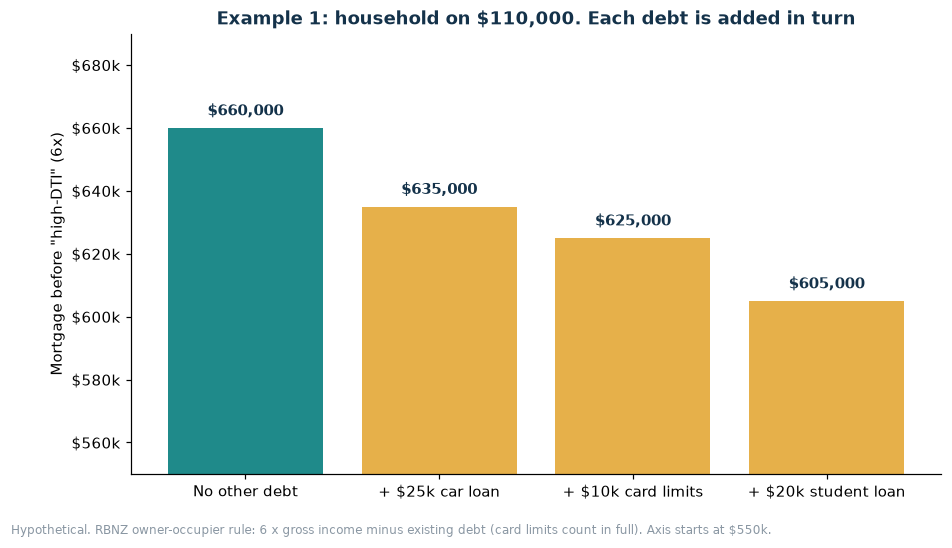
Example 1: How debts shrink your DTI limit
A couple earn $110,000 a year between them (before tax). Under the RBNZ owner-occupier rule:
| Debts | Sum | Most they can borrow before “high-DTI” |
|---|---|---|
| None | 6 × $110,000 | $660,000 |
| + $25,000 car loan | $660,000 − $25,000 | $635,000 |
| + $10,000 total card limits | $635,000 − $10,000 | $625,000 |
| + $20,000 student loan | $625,000 − $20,000 | $605,000 |
Every dollar of debt is a dollar less under the threshold. Cutting $10,000 of card limits they never use puts $10,000 straight back. Banks can still lend above 6×, but only a limited share of their lending (20%) can go to high-DTI loans, so being under the line generally makes things simpler.
Example 2: What a monthly repayment “uses up”
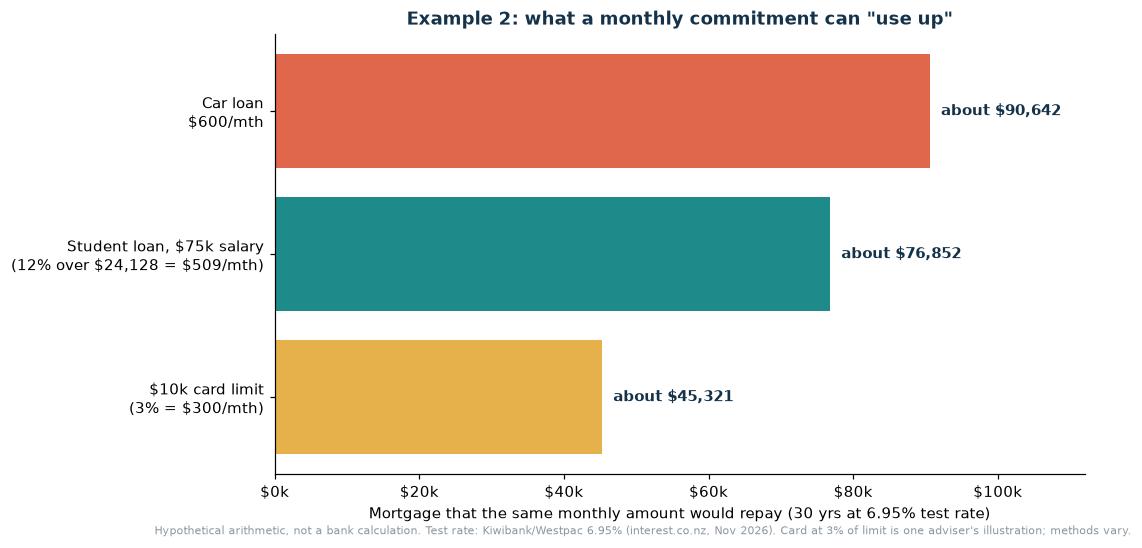
Affordability is about monthly cash flow. To see the scale, take a 6.95% test rate (Kiwibank’s and Westpac’s, per interest.co.nz) over 30 years, and ask how much mortgage the same monthly amount would repay:
- A $600/month car repayment ≈ $90,600 of mortgage.
- Student loan repayments on a $75,000 salary: ($75,000 − $24,128) × 12% = $6,104.64 a year, about $509 a month ≈ $76,900 of mortgage.
- A $10,000 card limit at an assumed 3% = $300 a month ≈ $45,300 of mortgage.
That’s not how much any bank would cut. Banks also factor in your living costs and their own policies. But it shows why a car repayment or a big card limit can matter more than people expect.
Example 3: Pay off the car, or keep the deposit?
Say you have $40,000 saved and a $12,000 car loan. Clearing it lifts your DTI headroom by $12,000 and frees up the monthly repayment, but it shrinks your deposit by $12,000 too. Which matters more depends on whether deposit or affordability is your bottleneck. That’s why advisers don’t automatically tell people to clear debts. Peters says it’s about “working out where their money is going to have the biggest impact” (NZ Adviser). Squirrel adviser Adam Clark says some approvals come with a condition that a personal loan is paid off at settlement, so you don’t always have to wait (same article).
05What “bad credit” actually means in NZ
“Bad credit” usually means something negative on your credit report. New Zealand has three credit reporting agencies: Centrix, Equifax and Experian (which took over illion) (Sorted; ClearScore).
What counts as a default
A default is an overdue payment of $125 or more, at least 30 days late, where the lender has asked you to pay and taken other steps to recover it (Credit Reporting Privacy Code). A power bill or phone bill that went to collections can count, not just loans (Sorted).
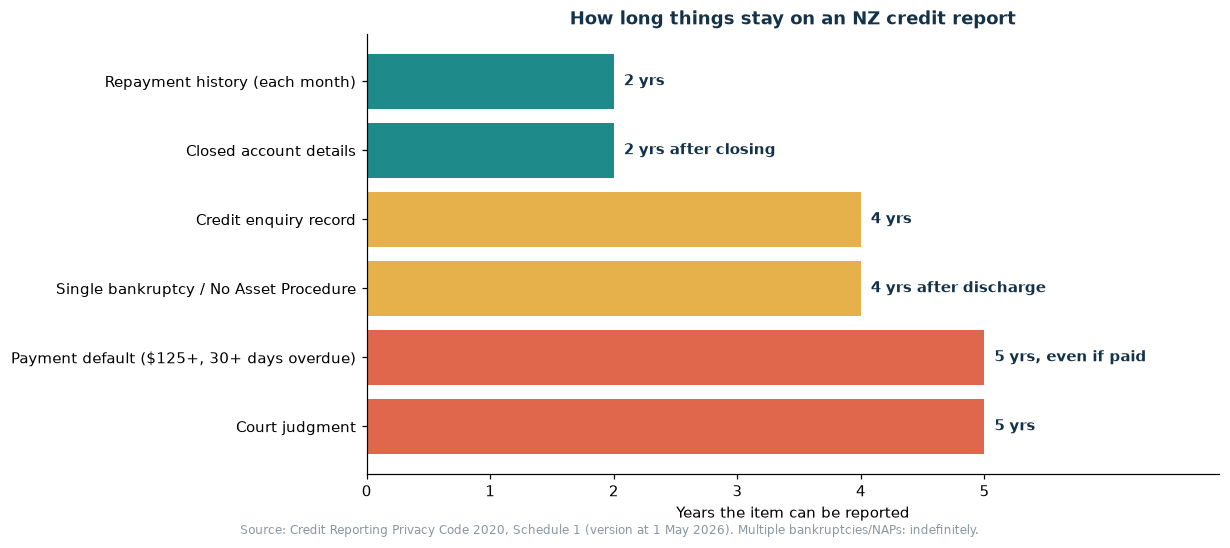
How long things stay on your file
| Item | How long it can be reported |
|---|---|
| Monthly repayment history | 2 years |
| Credit enquiries (applications) | 4 years |
| Single bankruptcy or No Asset Procedure | 4 years after discharge |
| Payment defaults | 5 years from the date of default |
| Court judgments | 5 years |
| Multiple bankruptcies/NAPs | Indefinitely |
Source: Credit Reporting Privacy Code 2020, Schedule 1.
A paid default still shows for the full five years, but lenders can see it’s been settled, so paying it still matters (Sorted). Centrix says the impact of a default “will reduce” over time (Centrix).
Your good habits count too
Since 2012, banks and other lenders have been allowed to report positive information too: your accounts, limits and whether each payment was on time (TSB). That’s called comprehensive credit reporting. In practice, two years of on-time payments after a rough patch is visible to a lender, not just the old default.
06Can I get a mortgage with a default?
It depends on how recent, how big and whether it’s paid, plus the rest of your application. Two things are worth knowing.
One lender’s no isn’t every lender’s no. The Banking Ombudsman says a decline from one lender “does not mean you won’t be able to obtain credit elsewhere”, because lenders have different criteria (Banking Ombudsman). Peters told NZ Adviser her team has been “declined by one or two banks and then the next bank has approved it” (NZ Adviser).
Some non-bank lenders cater for it. Some non-bank lenders grade applications by credit history. Some publish options that consider defaults registered more than 24 months ago, and specialist options for defaults under 24 months, at higher rates and fees than their prime loans. Advisers often treat that as a stepping stone. Clark’s aim is usually “to get back into a main bank, where pricing is better” (NZ Adviser).
07What to fix first: a short checklist
- Get your credit reports, free, from all three agencies. You’re entitled to a free copy from each, and checking your own report doesn’t affect your score (Sorted).
- Dispute anything wrong. Credit agencies must take reasonable steps to fix errors, and your file is flagged as disputed while they check (Credit Reporting Privacy Code).
- Settle any unpaid defaults. It won’t remove them, but “paid” reads better than “unpaid”.
- Cut card limits you don’t need, and close BNPL accounts. It’s often the quickest win for DTI and affordability.
- Hold off on new credit. Lots of credit checks in a short time can lower your score (Sorted). Don’t buy a car on finance mid-application.
- Tidy your bank statements. Pay everything on time, avoid unarranged overdrafts, and keep the last three months clean.
- Work out your bottleneck before using savings. Deposit or affordability? (See Example 3.)
08Where a mortgage adviser fits
You can go straight to your bank. An adviser can help when you’ve got debts or a credit blemish, because they know which lenders’ policies suit which situations and can test your scenario before an application goes in, so you don’t stack up enquiries. Most mortgage advisers are paid commission by the lender (FMA).
09FAQ
Can I get a mortgage with a car loan in NZ?
Yes, many people do. The car loan balance counts towards your DTI limit and the repayments reduce how much you can afford to borrow. Whether it matters depends on its size compared with your income and deposit.
Should I pay off my car loan before applying for a mortgage?
Not always. It helps your borrowing power but shrinks your deposit. Some lenders can approve a loan on the condition that a debt is cleared at settlement. Work out which is holding you back first.
Does Afterpay affect getting a mortgage?
It can. Since September 2024, BNPL providers credit-check customers and report to credit agencies, so BNPL accounts and missed payments can appear on your file. Advisers often suggest closing BNPL accounts before applying.
Do banks count my credit card limit or my balance?
The limit. For DTI, the RBNZ says banks look at the card limit, not the balance. Lowering limits you don’t use is one of the easiest fixes.
Does a student loan affect how much I can borrow in NZ?
Yes. The balance counts in the DTI sum, and repayments of 12% of income over $24,128 a year come out of your pay before you see it.
How long does a default stay on my credit report in NZ?
Five years from the date of default, even if you pay it. Single bankruptcies and No Asset Procedures can be reported for four years after discharge.
Can I buy a house with bad credit in NZ?
Sometimes. It depends on how recent and serious the problem is, whether it’s been paid, and the rest of your application. Main banks, non-bank lenders and government-backed First Home Loans all have different criteria.
What credit score do I need for a mortgage in NZ?
There’s no single number. Each agency uses its own scale. On Centrix’s 1–1000 scale, “a good score is considered more than 705” (Centrix), but lenders look at your whole report, income and debts, not just the score.
10How to use the form
The form is at apply.alfredassistance.com. Most questions are tap-to-choose answers in ranges, not exact figures. The exact questions change with your answers. Here’s what it asks.
- What you’re looking to do. Buy your first home, buy your next home, refix, switch banks, borrow more on your home, or buy an investment property. Pick the one closest to what you want help with.
- Your loan and timing. Whether you already have a mortgage adviser and where the property is. Then, depending on your first answer, things like your timing, roughly how much is left on your mortgage (or how much you’d need to borrow), and who your mortgage is with now.
- You and your finances. Who’ll be on the loan, residency status, household income before tax, how you’re paid, any other debts, and how you’d describe your credit history. The form notes that an honest credit history answer doesn’t affect your credit score.
- Your call. Whether you’re ready to go ahead if the adviser can get it sorted, and what times suit you for a call. There’s also an optional box for anything the adviser should know. Please don’t put account, card or ID numbers in it.
- Your details and a text code. Your first name, last name, email and NZ mobile. You check your answers, tap Text me my code, then type the 6-digit code from the text and tap Confirm and send my enquiry.
What happens after you send it. If we can match your enquiry, it goes to one mortgage adviser in our network, not several, who works under a licensed Financial Advice Provider, and you’ll get a text telling you who it is. They may be based anywhere in New Zealand, not necessarily near you.
It’s free. Alfred never charges you, whether or not we can match your enquiry: adviser firms pay Alfred for introductions. There’s no credit check to enquire.
Start the form →11Sources
All accessed 16 November 2026 (NZDT) unless noted.
- Privacy Commissioner, Credit Reporting Privacy Code 2020
- Centrix, October 2026 Credit Indicator
- NZ Adviser, Choosy buyers slow NZ loan approvals as enquiries rebound
- ANZ, How to apply for a home loan
- RBNZ, Understanding debt-to-income restrictions
- RBNZ, Reserve Bank maintains LVR settings
- FMA, Assessing for affordability
- FMA, Credit Contracts and Consumer Finance Act
- interest.co.nz, Home loan test rates
- LookAhead, Can you get a mortgage with debt in NZ?
- RNZ, Here's why it could get harder to extend your Afterpay
- Consumer Protection, Buy Now Pay Later
- NZ Adviser, The 'almost approved' borrower
- IRD, Repaying my student loan when I earn salary or wages
- Work and Income MAP, Student loan repayment thresholds, effective from 1 April 2026: $24,128, 12c in the dollar
- Sorted, How to get free credit reports in NZ
- ClearScore NZ Help Centre, Your ClearScore report is now powered by Experian
- Centrix, My Credit Report FAQs
- TSB, Comprehensive Credit Reporting
- Banking Ombudsman, Credit reports quick guide
- FMA, Mortgage advice


