
The short answer
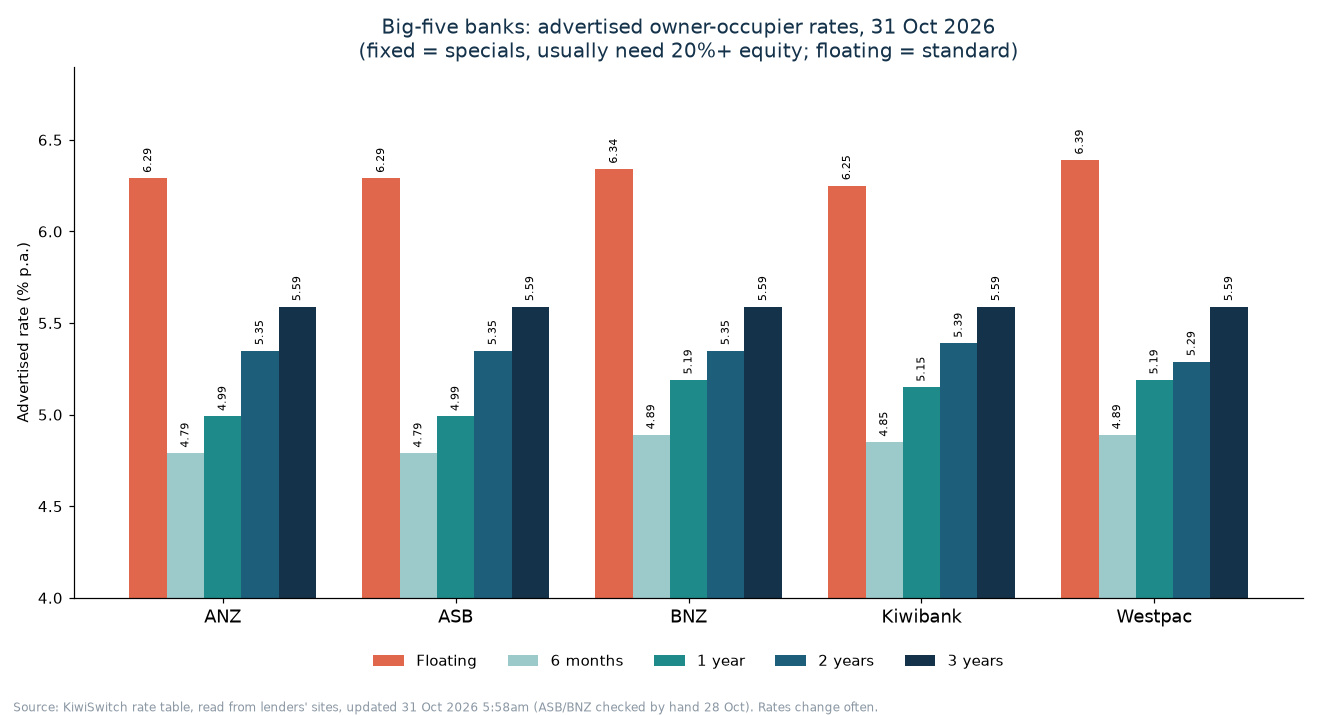
When your fixed rate ends, your bank moves you onto its floating rate unless you choose something else. Floating is well above short-term fixed rates right now: about 6.25%–6.39% at the big five banks, against 4.99%–5.19% for a one-year special (31 October 2026). ANZ, Westpac and BNZ let you lock in a new rate up to 60 days before your term ends. So find your expiry date, get your bank’s offer in writing, compare it with the market, and lock something in before the roll-over date.
Rates checked 31 October 2026.
01Why this matters right now
If your fixed term ends in the next few months, you’re in a big crowd. Cotality estimates that around 54% of existing mortgages by value are due to reprice within 12 months NZ Adviser, 22 Oct 2026.
For the first time in a while, many of those borrowers are refixing higher, not lower. Reserve Bank figures show one- and two-year special rates averaged 4.97% and 5.27% in September, while the average rate on existing fixed loans was 4.80% (same source).
The backdrop has turned, too:
- The Reserve Bank raised the Official Cash Rate (OCR) on 8 July (2.25% to 2.50%) and again on 2 September (to 2.75%) Mortgage Sense, 2 Oct 2026.
- On 28 October 2026 it held the OCR at 2.75% in a 4–3 vote; three members wanted a rise to 3% RBNZ.
- The next decision, with a full Monetary Policy Statement, is Wednesday 9 December 2026 at 2pm RBNZ.
Tighter monetary policy is likely to be required but remains conditional on the economic outlook.
Economists don’t agree on what comes next. ANZ and ASB expect three more 0.25% rises, taking the OCR to 3.5%. Westpac sees a peak of 4% by September 2027, BNZ expects 3.75%, Kiwibank 3.25% in 2027, and NZIER just one more rise, in late 2027 NZ Adviser, Oct 2026.
Not every rate is rising. Westpac cut its 18-month special by 0.26% to 5.19% from 2 November, while noting that “Overall, our economists think interest rates are heading upwards over the next year” Westpac NZ, 30 Oct 2026.
Key takeaway
- More than half of mortgage value reprices within a year, and many people are refixing higher.
- Nobody knows where rates go next, so focus on what you can control: your date, your offer and your structure.
02What actually happens when your fixed rate ends
Do nothing, and you roll onto floating
All four big banks we checked say the same thing:
- ANZ: “If you don’t do anything before your fixed rate period ends, you’ll automatically switch to our floating rate” ANZ.
- Westpac: you’ll “automatically roll onto our Choices Floating interest rate” Westpac.
- BNZ: your loan “will automatically switch to a standard variable rate the day after your fixed term ends” BNZ.
- ASB: your loan “will automatically revert to our standard variable interest rate” ASB.
Floating isn’t all bad: you can make extra repayments or switch without break fees, which is why many people keep a small floating slice. As the default for your whole loan, though, it’s usually the expensive option right now.
You can usually lock in early
- ANZ lets you lock in a new fixed rate “up to 60 days before your fixed rate period ends” with a Reserve Rate Agreement. Change your mind and there’s a $25 non-utilisation fee ANZ.
- Westpac allows fixing “up to 60 days before the end of your current fixed term”, with a $25 fee to break or change a rate lock Westpac.
- BNZ lets you “ratelock” a rate for up to 60 days before your term ends BNZ.
Windows and fees vary, so check your own bank’s rules. A lock gives you certainty, but with ANZ you keep the locked rate even if rates fall afterwards, unless you pay to change it.
Refix day is a flexible moment
It’s one of the few times you can restructure without break fees. You can:
- Pay down a lump sum. Refix day “is also the one time you can pay off as much as you like with no break fee” Mortgage Sense.
- Split your loan across terms, or across fixed and floating (ASB, Westpac).
- Change your loan term. If rates rise, ASB says you may be able to extend your term (up to a 30-year maximum) to keep repayments the same ASB. That eases the weekly cost but usually means more interest overall.
- Move lenders if another bank’s deal is clearly better.

03What the choices can cost
1 · Letting it roll to floating
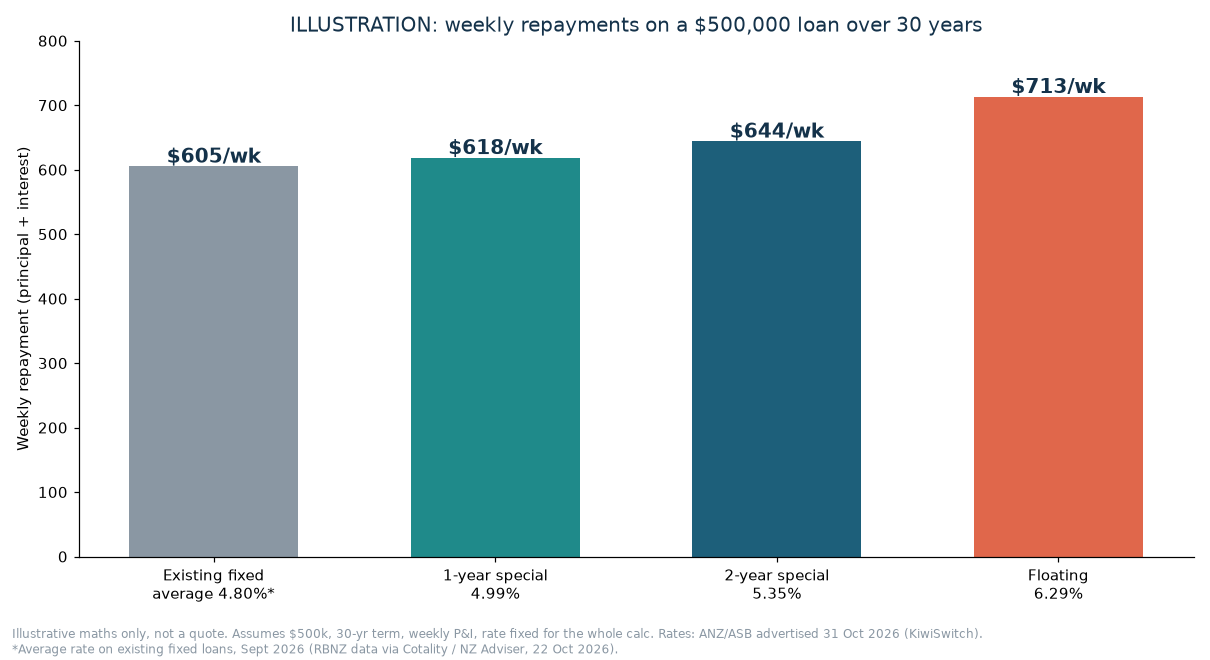
One-year special at 4.99% is about $618 a week; floating at 6.29% is about $713. Even a month on floating while you “get around to it” costs roughly $410 more.
2 · The refix bump
Coming off the September existing-fixed average of 4.80% (about $605 a week) onto September’s average two-year special of 5.27% (about $638) RBNZ via NZ Adviser. Budget for the new number before it arrives.
3 · One year or two?
One year at 4.99% (about $618) against two years at 5.35% (about $644): around $1,330 a year for the extra certainty. Mortgage Sense ran a similar sum on 4.95% vs 5.39% and got a $32-a-week gap Mortgage Sense.
4 · Splitting the difference
$250,000 on one year at 4.99% and $250,000 on two years at 5.35%. You don’t bet everything on one guess, and only half your loan reprices next year. Mortgage Sense calls splitting what it ends up “recommending most often”.
5 · A lump sum on refix day
Pay $10,000 off and refix $490,000 at 4.99%: repayments drop from about $618 to about $606 a week. Or keep paying the higher amount and clear the loan sooner.
04Your 7-step refix checklist
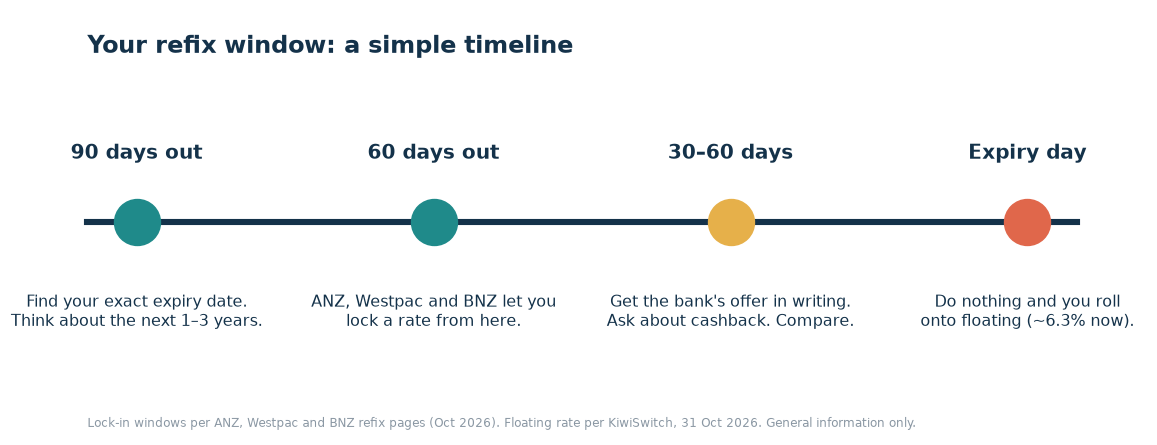
- Find your exact expiry date. It’s in your banking app or loan documents. On a split loan, each part may have its own date.
- Diary the lock-in date. At ANZ, Westpac and BNZ that’s 60 days before expiry. Check your bank’s window.
- Think about the next one to three years. Mortgage Sense suggests weighing life changes such as a baby, a renovation, a new job or selling, because breaking a fixed term early can cost money.
- Get your bank’s offer in writing. Don’t just tap “accept” on the rollover email or in the app.
- Ask about cashback and a sharper rate. Banks have retention offers, but they “rarely offer them if you just click ‘accept’ on the rollover email” Mortgage Sense. You usually have to ask.
- Compare with the wider market. A rate just 0.10 percentage points higher costs about $600 more in interest a year on a $600,000 loan KiwiSwitch. If another lender is clearly better, factor in any break fee, cashback clawback, legal costs and discharge fees before you switch.
- Lock it in, then diary the next one. Set a reminder for 60–90 days before your next expiry so it never auto-rolls again.
Key takeaway
- Start about 90 days out and lock in inside your bank’s window.
- Treat the rollover offer as a starting point. Ask, compare, then decide.
05Should you wait for the next OCR announcement?
Usually not. Fixed rates are priced off wholesale markets, which move ahead of Reserve Bank decisions. Before 28 October, a rise had been “almost 100 percent priced in”, according to Westpac’s chief economist RNZ, 28 Oct 2026. When the Bank held instead, the two-year swap rate fell about 13 basis points straight away NZ Adviser.
If your expiry falls close to 9 December, locking a rate inside your bank’s window gives you certainty. Some banks also let you change a lock for a small fee; check the terms first.
An unchanged OCR does not guarantee an unchanged mortgage rate, particularly for borrowers coming off an existing fixed term.
06Should you use a mortgage adviser to refix?
For a simple refix with your current bank, you can often do it yourself in the app, and many people do. An adviser tends to add the most when:
- you want your bank’s offer compared with other lenders
- you’re thinking about switching and want the cashback, clawback and break-fee maths done
- you want to restructure: a split, a lump sum, an offset or revolving slice, or a different term
- your circumstances have changed, such as self-employment, a new job, retirement plans or a top-up
On cost, the Financial Markets Authority says most mortgage advisers are paid commission by the lender: they “usually receive a payment from the lender as a percentage of the total loan amount” FMA. Advisers must tell you upfront how they’re paid. The FMA also warns to “be wary of short-term incentives such as cashback payments”, because they often lock you in for years.

07How to use the form
The form is at apply.alfredassistance.com. Most questions are tap-to-choose answers in ranges, not exact figures. The exact questions change with your answers. Here’s what it asks.
- What you’re looking to do. Buy your first home, buy your next home, refix, switch banks, borrow more on your home, or buy an investment property. Pick the one closest to what you want help with.
- Your loan and timing. Whether you already have a mortgage adviser and where the property is. Then, depending on your first answer, things like your timing, roughly how much is left on your mortgage (or how much you’d need to borrow), and who your mortgage is with now.
- You and your finances. Who’ll be on the loan, residency status, household income before tax, how you’re paid, any other debts, and how you’d describe your credit history. The form notes that an honest credit history answer doesn’t affect your credit score.
- Your call. Whether you’re ready to go ahead if the adviser can get it sorted, and what times suit you for a call. There’s also an optional box for anything the adviser should know. Please don’t put account, card or ID numbers in it.
- Your details and a text code. Your first name, last name, email and NZ mobile. You check your answers, tap Text me my code, then type the 6-digit code from the text and tap Confirm and send my enquiry.
What happens after you send it. If we can match your enquiry, it goes to one mortgage adviser in our network, not several, who works under a licensed Financial Advice Provider, and you’ll get a text telling you who it is. They may be based anywhere in New Zealand, not necessarily near you.
It’s free. Alfred never charges you, whether or not we can match your enquiry: adviser firms pay Alfred for introductions. There’s no credit check to enquire.
Start the form →08Frequently asked questions
What happens if my fixed rate ends and I don’t refix?
Your loan moves onto your bank’s floating or standard variable rate. ANZ, ASB, BNZ and Westpac all say this on their refix pages. On 31 October 2026, big-five floating rates were about 6.25%–6.39% KiwiSwitch. You can usually fix again at any time while floating.
How early can I refix my mortgage in NZ?
At ANZ, Westpac and BNZ you can lock in a new rate up to 60 days before your current term ends. Other lenders may differ, so check with yours.
Can I change my mind after locking in a rate?
Often yes, for a fee. ANZ charges a $25 non-utilisation fee to cancel or change a Reserve Rate Agreement, and Westpac charges $25 to break or change a rate lock. Once the new fixed term starts, normal break costs can apply.
Should I fix for one or two years right now?
It depends on your budget and how much certainty you want. On 31 October 2026, big-five one-year specials were 4.99%–5.19% and two-year specials 5.29%–5.39% KiwiSwitch. Many borrowers split across terms so they’re not relying on one guess. An adviser can help you weigh it up for your situation.
Can I get cashback when I refix?
Sometimes. Banks have retention offers, but you usually need to ask Mortgage Sense. Cashback usually comes with a clawback if you leave within a set period, often three or four years KiwiSwitch. Compare it with the interest cost of any rate difference.
Do I have to pass the DTI rules again to switch banks?
The Reserve Bank’s debt-to-income (DTI) restrictions don’t apply when refinancing a mortgage “where the new loan value doesn’t exceed the original loan value” RBNZ. The new lender will still run its own credit and affordability checks.
When is the next OCR announcement?
Wednesday 9 December 2026 at 2pm NZT, with a Monetary Policy Statement RBNZ.
09Sources
All accessed 31 October 2026 (NZDT).
- RBNZ · OCR held at 2.75% (28 Oct 2026)OCR hold, 4–3 vote, committee quote
- RBNZ · Monetary Policy Statement and OCR, December 2026Next decision date and time
- RBNZ · Understanding DTI restrictionsDTI and refinancing
- KiwiSwitch · NZ mortgage rate table (updated 31 Oct 2026)Big-five rates, chart, cashback clawback, cost of 0.10 pt
- Westpac NZ · Westpac NZ cuts fixed home loan rate (30 Oct 2026)18-month special cut
- ANZ · Home loan fixed term endingAuto-switch, 60-day Reserve Rate Agreement, $25 fee
- Westpac · Fix or refix a new rate60-day window, $25 lock fee, roll to Choices Floating
- BNZ · Re-fixing your loan60-day ratelock, standard variable rate
- ASB · Fixed rate loan about to expireStandard variable rate, term extension, splitting
- NZ Adviser · Mortgage rollovers to cost more… (22 Oct 2026)54% repricing, September average rates
- NZ Adviser · Split RBNZ holds OCR at 2.75%… (Oct 2026)Economists’ forecasts, swap move, Burkett quote
- RNZ · What will OCR surprise mean for home loan rates? (28 Oct 2026)“Almost 100 percent priced in”
- Mortgage Sense · Refixing before the 28 October OCR? (2 Oct 2026)OCR rises, retention offers, lump sums, splitting
- Financial Markets Authority · Mortgage adviceHow advisers are paid, cashback caution


