
The short answer
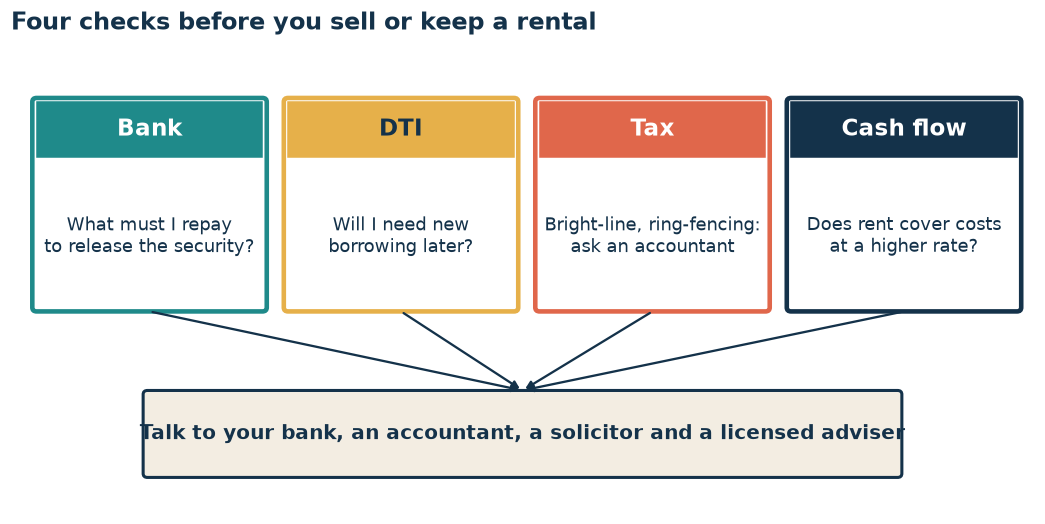
There’s no single right answer, and this article can’t give you one. What it can do is show you the checks that decide how the sale or the hold actually plays out. 1) If your properties are tied together under one bank, the bank can require some of your sale money to go towards your other loans, so you may keep less cash than you expect (Banking Ombudsman). 2) The Reserve Bank’s debt-to-income (DTI) rules look at your total debt against your gross income, so selling a rental can free up borrowing room, but only if you later want new lending (RBNZ). 3) Bright-line tax applies to sales within 2 years of the bright-line start date (usually settlement) (for sales from 1 July 2024), with exclusions (IRD). 4) The property may or may not cover its own costs, and a small rate change can flip that.
Checked 10 November 2026.
01Why so many landlords are asking this right now
If you’ve typed “should I sell my rental property or keep it” into Google, you’re in plenty of company. Some of the words real Kiwi investors have used in public posts:
- “We receive rental income of $700 p/w … which is not quite enough to cover mortgage, rates, insurance, tax, accounting expenses” and “Are we best to sell … and pay all our debt and invest our money elsewhere?” (r/PersonalFinanceNZ, “Sell and invest?”, February 2026)
- “Should we stick with it or sell up?” and “My wife says we’re up to the gunwales.” (an investor on Newstalk ZB, as quoted by Opes Partners, 21 Oct 2026)
- “Should I sell my rental before a capital gains tax comes in?” (the opening line of a LinkedIn post by a NZ property lawyer, June 2026)
The wider market backs up the mood. In Tony Alexander’s late-October survey, a net 47% of agents said they were seeing fewer investors, and a net 28% said they were seeing more investors looking to sell (OneRoof, 4 Nov 2026). New mortgage lending to investors fell from $1,735 million in September 2025 to $1,335 million in September 2026, about 23% (RBNZ data via b2bnews, 30 Oct 2026). Cotality pointed to flat rents, rising council rates and insurance, the election and tax uncertainty (same source). National property values were down 1.3% in the year to September, and more than 18% below their peak (Cotality, via NZ Adviser).
None of that tells you what to do with your property. A flat market is a reason to look carefully, not a reason to rush in either direction.
02What the election means (and doesn’t) for your decision
The election was on 7 November 2026, and there is no confirmed new government yet. On the preliminary count, the right bloc (National, ACT, NZ First) has 67 seats and the left bloc (Labour, Greens, Opportunity, Te Pāti Māori) has 64, but about 399,000 special votes are still to be counted and final results are due on 27 November. Coalition talks could run close to Christmas (interest.co.nz, 8 Nov 2026).
What that means for landlords:
- Current law hasn’t changed. Interest on residential rentals is 100% deductible from 1 April 2025 (IRD), and bright-line is 2 years.
- A capital gains tax (CGT) is a proposal, not law. Labour’s policy is a 28% tax on profit made after 1 July 2027 when investment or commercial property (not the family home) is sold. No profit made before July 2027 would be taxed (interest.co.nz, policy list as of 16 Oct). Labour would also keep interest deductibility. National, ACT and NZ First would keep interest deductibility too, though ACT also proposes abolishing loss ring-fencing for rentals (NZ Adviser/ASB; interest.co.nz). The Greens would remove interest deductibility and bring in a 10-year bright-line test, and Labour has ruled out supporting the Greens’ tax policies (NZ Adviser/ASB). These are all policies, not law.
- Expect uncertainty to last a few weeks. KPMG expects tax settings to “largely remain unchanged for the short term” apart from a possible CGT if Labour leads (KPMG NZ).
Selling purely to beat a tax that may never exist is a big call. A proposed CGT would only reach gains made after 1 July 2027, so the maths is different from what many people assume. If tax is driving your decision, an accountant can model it for your situation.
03Check 1: Will the bank let you keep the sale money?
This is the one that catches people out, and it matters most if you hold several properties with the same bank.
Most mortgages are “all obligations” mortgages: the security covers everything you owe that bank, now and in future. So when you sell one property, the Banking Ombudsman says banks “won’t automatically let you keep the entire balance”, and it’s a regular source of complaints (Banking Ombudsman Scheme). The bank may direct leftover proceeds to your other loans if the remaining property’s loan-to-value ratio isn’t acceptable, its lending criteria have changed, your finances have changed, or values have fallen.
One Ombudsman case note: a couple sold an investment property expecting to keep the proceeds after repaying that loan. The bank held an interlocking guarantee over both properties, and decided to use the proceeds to help repay the other loan, partly because losing the rental reduced their income. The complaint wasn’t upheld (case note 70418).
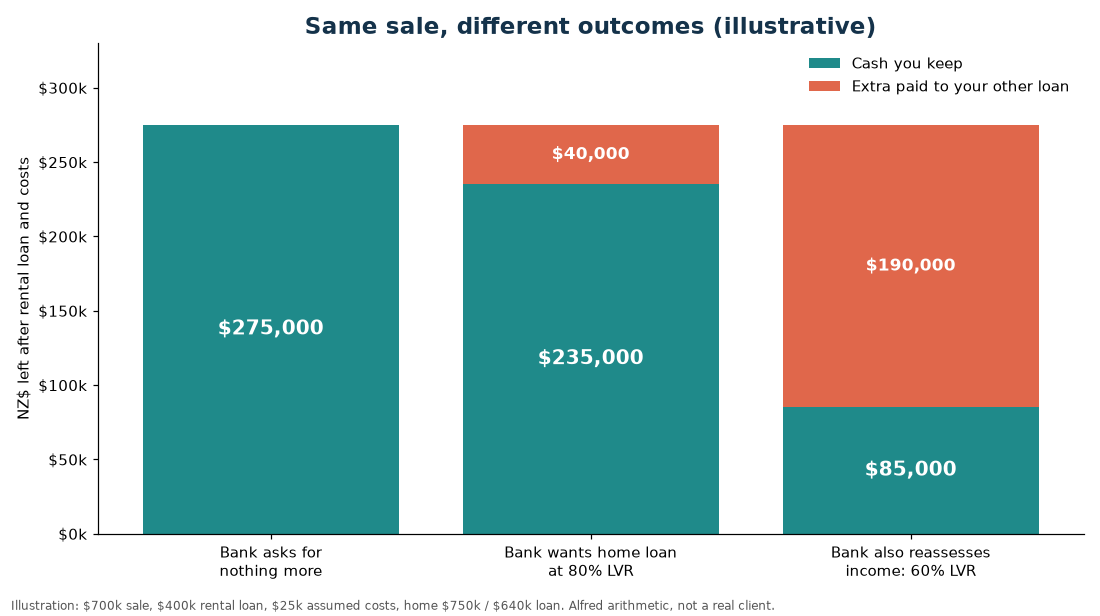
Worked example 1: the same sale, three outcomes
A couple own a home valued at $750,000 with a $640,000 loan (85% LVR), and a rental they sell for $700,000 with a $400,000 loan. They assume selling costs of $25,000 (agent, legal and marketing; get real quotes).
- Money left after the rental loan and costs: $700,000 − $400,000 − $25,000 = $275,000
- If the bank asks for nothing more: they keep $275,000
- If the bank wants the home loan at 80% LVR ($600,000): they pay $40,000 more, keeping $235,000
- If the bank also reassesses their income now the rent is gone and wants 60% LVR ($450,000): they pay $190,000 more, keeping $85,000
Paying down your own home loan isn’t a loss, since your debt drops too. The point is that the cash you planned to use may be much smaller than you expected. The Ombudsman’s advice: talk to your bank first, so you know how much it wants repaid before you sell, and note that breaking a fixed rate to pay down a loan can trigger an early repayment charge (Banking Ombudsman).
Questions to ask your bank before listing: What do I need to repay to release this property? Will you confirm that in writing? Does any fixed-rate break cost apply? How is my remaining income assessed? If your loans are spread across different banks, selling may mean dealing with only one lender’s loan, which is one reason some advisers suggest separate security. That’s a conversation for a mortgage adviser working under a licensed Financial Advice Provider, and a solicitor, and it’s not something to change on a whim.
04Check 2: DTI counts total debt, and it only bites when you borrow
Since 1 July 2024 banks have to follow the Reserve Bank’s debt-to-income (DTI) rules on new home lending. Banks can put up to 20% of new investor lending above a DTI of 7, and 20% of owner-occupier lending above 6. DTI is total debt ÷ gross (before-tax) income, and credit card limits count as debt, not just balances (RBNZ). That’s why multi-property owners often find the rules harsh: every rental loan stacks onto the same total.
Two details worth knowing:
- Refinancing without increasing the loan is exempt, as is moving a loan to another property without increasing it (RBNZ). So if you simply keep everything and refix, DTI usually isn’t the issue. It matters when you want new borrowing: a top-up, another purchase, or buying again after a sale.
- The formula uses your total debt. Splitting loans across banks may help with security and proceeds (Check 1), but it doesn’t change the total.
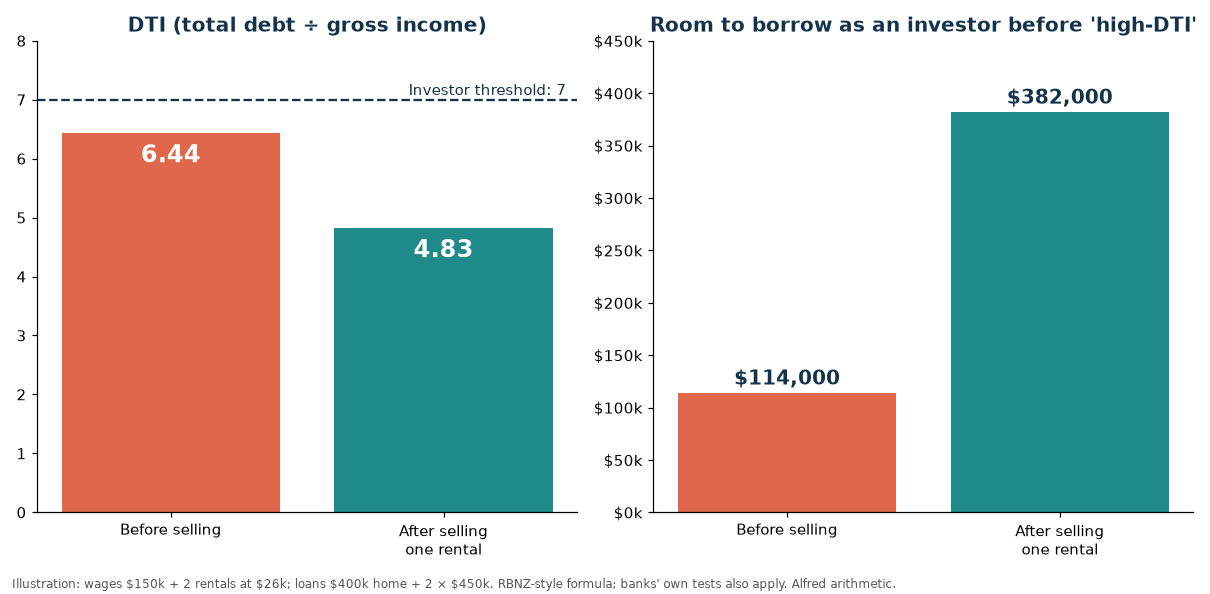
Worked example 2: how selling one rental changes DTI headroom
A couple earn $150,000 in wages combined. They own a home with a $400,000 loan and two rentals, each with a $450,000 loan and rent of $500 a week ($26,000 a year).
- Before selling: income = $150,000 + $26,000 + $26,000 = $202,000; debt = $400,000 + $450,000 + $450,000 = $1,300,000; DTI = 6.44. Room to borrow before a new investment loan counts as high-DTI: 7 × $202,000 − $1,300,000 = $114,000.
- After selling one rental and clearing its loan: income = $176,000; debt = $850,000; DTI = 4.83. Room as an investor: 7 × $176,000 − $850,000 = $382,000. Room if buying a home to live in (threshold 6): 6 × $176,000 − $850,000 = $206,000.
So selling can open up room, but it also removes rental income, and a bank’s own servicing test still applies on top of DTI. The RBNZ notes that banks do their own affordability checks (RBNZ). If you’re already declined or capped by a bank because of existing rental debt, you’re not alone, and each lender applies the rules in its own way.
05Check 3: Tax, briefly
- Bright-line: for property sold on or after 1 July 2024, any profit is taxable if you sell within 2 years of the bright-line start date (generally settlement). It generally doesn’t apply to a property that has been your main home (when criteria are met), but other land-sale rules can still apply, for example if you bought with the intention of selling (IRD). If you’re considering turning your old home into a rental and selling later, get the main-home detail checked before you rely on it.
- Interest: 100% of interest on residential rental borrowing is claimable from 1 April 2025, subject to the usual rules (IRD).
- Ring-fencing: excess rental deductions can’t offset your salary. They carry forward against future rental income, including income from a property sale (IRD). Selling a property can therefore matter for carried-forward losses.
- Possible CGT: only a proposal at this stage (see above).
06Check 4: Does the property pay its own way?
Ilse Wolfe, who owns 30+ properties, told The Post (13 May 2026): “Early in our investing journey we did not prioritise cashflow enough and we almost lost everything because of it.” Cash flow is a good stress test whether you’re keeping or selling.
Worked example 3: rent vs costs, and a 1% rate change
A rental is worth $750,000 with a $450,000 interest-only loan (equity $300,000). Rent is $700 a week.
- Rent: $700 × 52 = $36,400 a year
- Interest at an assumed 5%: $22,500; council rates $3,500; insurance $2,500; maintenance $3,000 → costs $31,500
- Left over before tax and loan repayments: $4,900 a year, about 1.6% of the $300,000 equity
- If the rate were 6%: interest is $27,000, costs $36,000, and the property runs about $3,600 a year short
Interest rates are a live issue. The OCR is 2.75%, with the next decision on 9 December 2026, and the Reserve Bank says inflation is above target (RBNZ). Tony Alexander expects a “very high probability” of tightening in December (OneRoof). That’s one economist’s view, and banks set their own rates. If a loan is interest-only, check when the term ends. Repayments can step up when it switches to principal and interest, and renewal of an interest-only term is at the lender’s discretion.
If you sold, the equity would stop earning a return from the rental, but the interest on whatever debt it repaid would stop too. Whether that’s better depends on the alternative, on tax, and on how you feel about risk. That’s personal, and it’s why an adviser conversation helps.
07FAQ
Should I sell my rental before a capital gains tax comes in?
A CGT is only proposed (Labour, 28% on gains after 1 July 2027), and there’s no confirmed government yet (interest.co.nz). The proposal wouldn’t tax profit made before July 2027.
Do I pay tax if I sell a rental?
It depends on how long you’ve held it, how you’ve used it and why you bought it. Bright-line applies to sales within 2 years (from 1 July 2024), and other land-sale rules can apply (IRD).
Will I get all the money left after selling?
Not necessarily. If your properties share security with one bank, it can require sale proceeds to reduce other loans (Banking Ombudsman). Ask your bank before you list.
Does selling one rental help with DTI?
It lowers total debt and your income, so it can free DTI room if you later want new borrowing, but banks also run their own affordability tests (RBNZ).
Does DTI apply if I just refix or refinance?
Refinancing where the new loan doesn’t exceed the original is exempt from the DTI rules (RBNZ). Banks still apply their own checks.
Can I claim interest on my rental mortgage?
Yes. From 1 April 2025 you can claim 100% of interest on residential rental borrowing, subject to general deductibility rules (IRD).
Does splitting my loans across banks lower my DTI?
No. The formula uses your total debt. Separate lenders can change who controls your sale proceeds, but not the total.
08How to use the form
The form is at apply.alfredassistance.com. Most questions are tap-to-choose answers in ranges, not exact figures. The exact questions change with your answers. Here’s what it asks.
- What you’re looking to do. Buy your first home, buy your next home, refix, switch banks, borrow more on your home, or buy an investment property. There isn’t a separate option for selling, so pick the one closest to what you want help with and mention your plans in the notes box near the end.
- Your loan and timing. Whether you already have a mortgage adviser and where the property is. Then, depending on your first answer, things like your timing, roughly how much is left on your mortgage (or how much you’d need to borrow), and who your mortgage is with now.
- You and your finances. Who’ll be on the loan, residency status, household income before tax, how you’re paid, any other debts, and how you’d describe your credit history. The form notes that an honest credit history answer doesn’t affect your credit score.
- Your call. Whether you’re ready to go ahead if the adviser can get it sorted, and what times suit you for a call. There’s also an optional box for anything the adviser should know. Please don’t put account, card or ID numbers in it.
- Your details and a text code. Your first name, last name, email and NZ mobile. You check your answers, tap Text me my code, then type the 6-digit code from the text and tap Confirm and send my enquiry.
What happens after you send it. If we can match your enquiry, it goes to one mortgage adviser in our network, not several, who works under a licensed Financial Advice Provider, and you’ll get a text telling you who it is. They may be based anywhere in New Zealand, not necessarily near you.
It’s free. Alfred never charges you, whether or not we can match your enquiry: adviser firms pay Alfred for introductions. There’s no credit check to enquire.
Start the form →09Sources
All accessed 10 November 2026 (NZDT) unless noted.
- Banking Ombudsman Scheme, Freeing up capital (updated Feb 2022)
- Banking Ombudsman Scheme, case note 70418
- RBNZ, Understanding DTI restrictions (updated 23 Dec 2025)
- RBNZ, Official Cash Rate (28 Oct 2026)
- IRD, The bright-line test
- IRD, Residential property interest limitation rules
- IRD, Residential rental property deductions (ring-fencing)
- interest.co.nz, election result (8 Nov 2026)
- interest.co.nz, housing policies (as of 16 Oct 2026)
- KPMG NZ, What an unclear 2026 election result means for tax policy
- NZ Adviser, Election 2026: where the parties stand
- OneRoof / Tony Alexander, 4 Nov 2026
- b2bnews, investor lending (RBNZ data), 30 Oct 2026
- r/PersonalFinanceNZ, "Sell and invest?" (Feb 2026)
- Opes Partners, Private Property issue 229, "Was buying a rental a $150k mistake?" (21 Oct 2026)
- The Post, "Investor owns more than 30 properties, but she and her family rent" (13 May 2026)
- Adam Siddall (NZ Legal), LinkedIn post, June 2026


