
The short answer
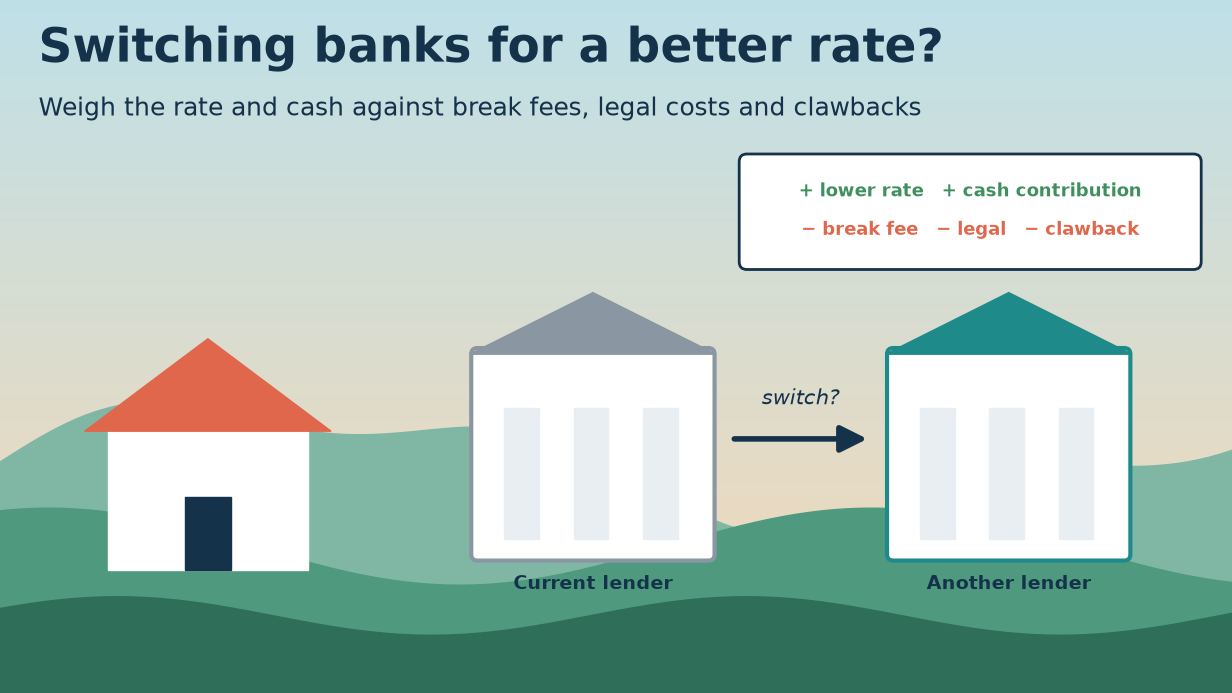
Switching banks can be worth it in New Zealand, but only when the lower rate and any cash contribution add up to more than the costs of moving. Those costs are legal fees (Kiwibank puts them at about $900–$2,000 plus GST), your old bank’s discharge fee, a break fee if you leave a fixed rate early, and any cashback you’d have to repay. Moving when a fixed term ends usually avoids the break fee. And before you go, ask your own bank what it will do to keep you: advisers say retention cash of about 0.25%–0.4% of the loan is common.
Rates and fees checked 1 November 2026.
01Why so many Kiwis are asking this right now
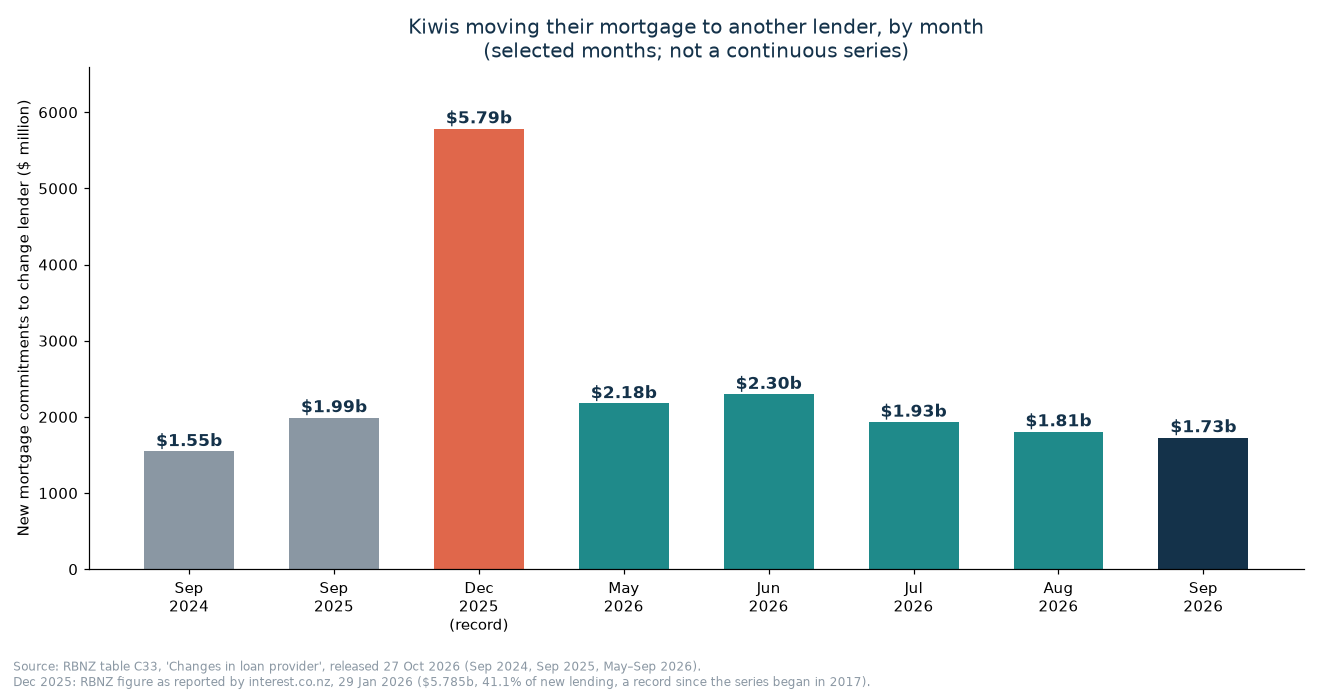
Switching hit a record last summer. In December 2025, $5.785 billion of new mortgage lending (41.1% of the month’s total) was people moving to a different lender. That’s the highest in a Reserve Bank series that started in 2017 (interest.co.nz, 29 Jan 2026).
It has cooled since: September 2026 saw $1.729 billion of switching, down from $1.992 billion a year earlier (RBNZ table C33).
The rate backdrop has also shifted. The Reserve Bank held the Official Cash Rate (OCR) at 2.75% on 28 October 2026, in a 4–3 vote. All members agreed “tighter monetary policy is likely to be required but remains conditional on the economic outlook” (RBNZ). The next decision is on Wednesday 9 December 2026 (RBNZ).
Meanwhile, advertised rates at the main banks are close together but not identical. On 1 November, one-year specials ranged from 4.99% to 5.19% and floating rates from 6.25% to 6.39% at ANZ, ASB, BNZ, Kiwibank and Westpac (KiwiSwitch). Some lenders are still moving: Westpac cut its 18-month special to 5.19% from 2 November (Westpac NZ, 30 Oct 2026).
So the question is whether a gap of 0.10–0.20 points, plus any cash, beats the cost of moving.
02What it costs to switch banks in NZ
1. Legal fees
Moving your mortgage means a lawyer (or the new bank’s legal service) has to discharge the old mortgage and register the new one. Kiwibank says the legal work “could be anywhere from $900 to $2,000 (plus GST and disbursements)” depending on where you live and how complex your security is (Kiwibank).
Some banks cover this for eligible switchers:
- BNZ Home Loan Switch: if you qualify, “you won’t have to find your own lawyer, or pay for legal fees”, which BNZ says “could save you up to $2,500” (BNZ).
- Kiwibank Refinancing Package: a free legal transfer service if you meet criteria, including a loan of at least $50,000 and 20% equity. Your old bank’s break costs and discharge fees “aren’t covered” (Kiwibank).
2. Your old bank’s discharge fee
This one is small. Published examples: ANZ charges $100 (ANZ fees, effective 23 Oct 2026), BNZ $40 per deed (BNZ) and Kiwibank $35 for a full discharge (Kiwibank). The new lender may also have a set-up fee, such as BNZ’s “up to $150”.
3. A break fee, if you leave a fixed rate early
This is the cost that can sink a switch. If you repay a fixed loan before the term ends, banks charge a break fee (Westpac calls it a prepayment cost). Westpac says it’s based on the difference between the wholesale rate when it funded your loan and the wholesale rate on the day you repay (Westpac).
In plain terms: if wholesale rates have fallen since you fixed, you’ll probably pay. If they’ve risen, there’s usually little or no charge. Kiwibank also says break costs vary “depending on the current interest rates and how long the fixed term has left to run” (Kiwibank).
The simplest way to avoid a break fee is to switch when your fixed term ends. Floating loans can usually be moved without one.
4. Cashback clawback
If you took a cash contribution from your current bank, you agreed to stay for a set time, usually three or four years. Leave earlier and you’ll repay some or all of it (KiwiSwitch). Kiwibank’s clawback period is four years (Kiwibank).
There is some good news here. The Commerce Commission said clawbacks act “as a dis-incentive to switch” and recommended they be pro-rated, reducing each month (Commerce Commission, Apr 2025). By September 2025, ANZ had implemented this in full, and most other banks had plans to finish by the end of that year (Commerce Commission, 12-month report). Check your own loan documents for your exact terms.
5. An adviser clawback fee (sometimes)
If a mortgage adviser arranged your current loan and you move within a set period, the bank can claw back the adviser’s commission. The adviser may then pass that cost on to you, but only if they clearly told you upfront. In one Financial Services Complaints Ltd case, an adviser had disclosed a fee for switching within 30 months, and the borrower ended up paying $2,500 (FSCL). Look for this in your adviser’s terms of business.
03What you might gain
A lower rate
Even small gaps add up on a big loan. KiwiSwitch notes that on a $600,000 loan, a rate just 0.10 percentage points higher costs about $600 more in interest a year (KiwiSwitch).
A cash contribution from the new bank
No main bank publishes a switching cashback figure. It’s negotiated. Mortgage broker Squirrel said in November 2025 that “the standard cash contribution on offer is between 0.80% and 0.90%” of the loan, usually for loans of at least $250,000 (Squirrel). In March 2026, one adviser put it at “up to 0.9 percent or even 1 percent” for new or refinanced lending (RNZ).
…or a better deal for staying
Banks also pay to keep customers. Advisers told RNZ that retention payments are often “between 0.25 percent to 0.4 percent of the lending amount”. One said the retention cash “looked about the same as the refinance cash less legal fees, not to mention the effort required to actually make the change” (RNZ, 24 Mar 2026). ANZ told RNZ that “our bankers can sometimes offer cash contributions to existing customers”. You usually have to ask.
04Worked examples: does switching stack up?
Example 1: Switch for 0.20% lower, with cash
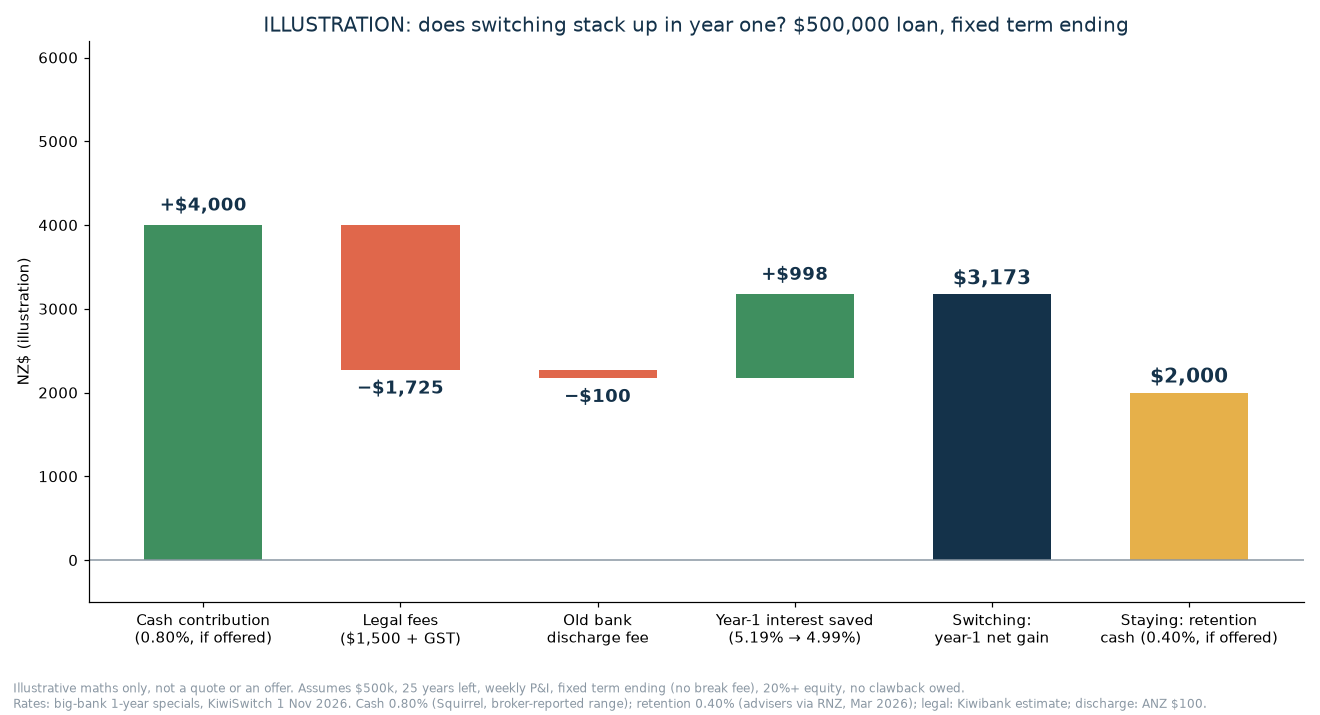
Assumes a $500,000 loan with 25 years left, repaid weekly.
- Stay at 5.19%: about $687 a week
- Switch to 4.99%: about $673 a week, around $13 a week less
- Interest saved over the first year: about $998
- Cash contribution at 0.80%: $4,000
- Less legal fees ($1,500 + GST = $1,725) and a $100 discharge fee
- Year-one net gain: about $3,173
Compared with simply rolling over at 5.19%, that’s a clear win in this example. The catch is that the $4,000 usually comes with a three- or four-year clawback, so you’re committing to that bank for a while.
Example 2: Ask your bank first
Say your bank offers 0.40% retention cash ($2,000) but keeps you at 5.19%. Switching (Example 1) is still about $1,173 ahead in year one. That’s real money, but it’s a much closer call once you add the time, paperwork and a new credit application.
Example 3: Switching for the rate alone
Same move to 4.99%, but no cash contribution. You save about $998 in interest in year one, but pay about $1,825 in legal and discharge fees, so you’re about $827 behind after year one. A small rate gap on its own often takes more than a year to pay back the cost of moving, unless the new bank covers your legal fees.
Example 4: Breaking mid-term
Westpac’s own guide shows the scale. With two years left on a fixed loan and wholesale rates 1.00 percentage point lower than when you fixed, the indicative prepayment cost is about $1,856 per $100,000 (Westpac prepayment guide). On $500,000 that’s roughly $9,280, which would wipe out a typical cash contribution. If wholesale rates have risen since you fixed, the cost may be much smaller or nil. Always get a written quote.
Example 5: A clawback on your old cashback
Say you got $5,000 cash 18 months ago, with a three-year clawback that reduces monthly. You’d owe back about half, roughly $2,500. That comes straight off any gain from moving.
05Credit checks and lending rules when you switch
Will switching affect my credit score?
Applying to a new lender means a credit check. Consumer Protection says lenders look at “recent applications for credit”, and advises you to “only apply for credit when you need it, as each application may lower your score” (Consumer Protection). So it pays to narrow your options before you apply. The Commerce Commission notes that lenders now give mortgage advisers “rate cards” showing rates and discretionary discounts, so advisers can gauge offers without a formal application first (Commerce Commission).
Do the LVR and DTI rules apply?
Not to a like-for-like switch. The Reserve Bank’s LVR restrictions don’t apply to “refinancing a mortgage, where the new loan value doesn’t exceed the original loan value” (RBNZ). The DTI rules have the same exemption (RBNZ). Borrow more as part of the switch and the extra can count.
But banks “will still apply their own lending criteria” and may lend only at lower LVRs (RBNZ). Special rates usually need at least 20% equity (KiwiSwitch), so switching with a small deposit is harder.
Affordability checks
Lenders must still make reasonable inquiries to be satisfied you can repay “without suffering substantial hardship”. The detailed affordability regulations were revoked from 31 July 2024, so lenders now take a more risk-based approach (FMA). Since 1 July 2026, the FMA has been the regulator for consumer credit law (FMA).
06Your switching checklist
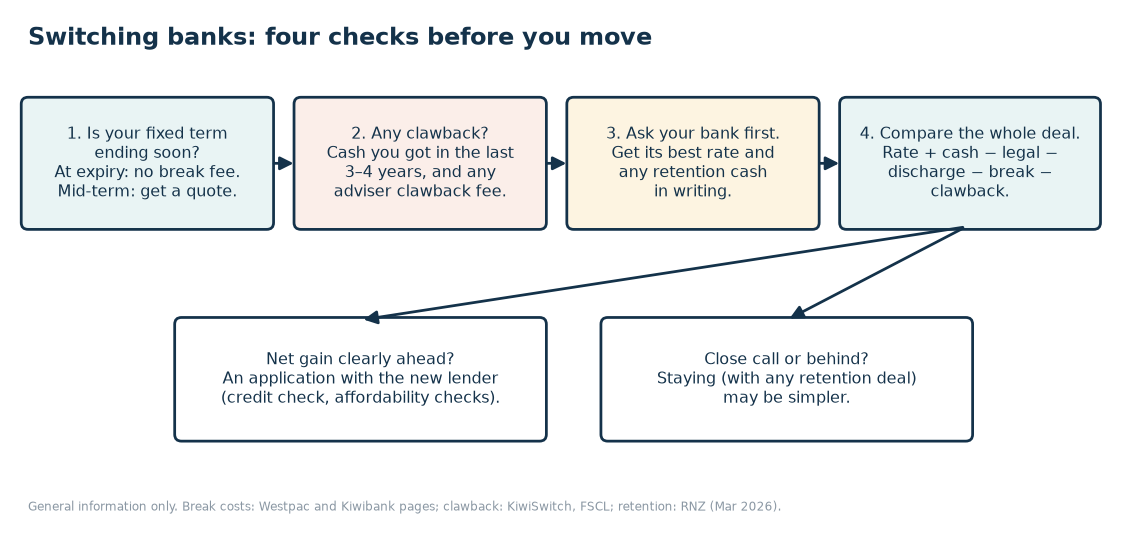
- Find your fixed-term end date. Aim to move then, to avoid a break fee. If you’re mid-term, ask for a written break-fee quote.
- Check for clawbacks. Look for any cashback received in the last three or four years, and check your adviser’s terms for a clawback fee.
- Ask your current bank first. Ask for its best rate and any retention cash, in writing.
- Get the new lender’s whole offer. That means the rate, any cash, the clawback period and whether legal fees are covered.
- Compare like for like. The NZ Banking Association’s home loan comparison calculator on interest.co.nz turns cash, fees and clawbacks into an effective rate for up to three offers.
- Think beyond year one. Accepting cash ties you to that bank for three or four years. Consider whether you might sell, top up or restructure in that time.
- Then decide. If staying is nearly as good, staying is a perfectly reasonable choice.
07Should you use a mortgage adviser to switch?
You can switch on your own by applying directly to another bank. An adviser tends to help most when you want offers from several lenders compared, the cashback, clawback and break-fee maths done for you, or the loan restructured as part of the move.
The FMA says most mortgage advisers are paid by the lender, usually “as a percentage of the total loan amount”. Advisers must tell you upfront how they’re paid. The FMA also warns to “be wary of short-term incentives such as cashback payments”, because they can lock you in for years (FMA).
08Frequently asked questions
Is it worth switching banks for a 0.2% lower mortgage rate?
Sometimes. On a $500,000 loan, 0.20 percentage points is worth roughly $1,000 of interest a year (Example 1). That can be less than the legal and discharge costs of moving, unless a cash contribution or free legal service is part of the deal. Do the full sum for your loan.
How much does it cost to switch mortgage banks in NZ?
Legal fees are typically about $900–$2,000 plus GST and disbursements (Kiwibank’s estimate), unless the new bank covers them. Add your old bank’s discharge fee ($35–$100 at the banks we checked), plus any break fee and cashback clawback.
Will I have to pay back my cashback if I switch?
If you leave within the clawback period, usually three or four years, you’ll repay some or all of it. Most banks now reduce the amount the longer you stay. Check your loan documents.
Can I switch banks in the middle of my fixed term?
Yes, but you’ll usually pay a break fee if wholesale rates have fallen since you fixed. Ask your bank for a written quote, and compare it with what you’d gain.
Do I need a lawyer to switch banks?
Usually, yes. But BNZ’s Home Loan Switch and Kiwibank’s Refinancing Package can handle the legal work for eligible borrowers at no charge.
Can I switch with less than 20% equity?
Possibly. A like-for-like refinance is exempt from the Reserve Bank’s LVR limits, but banks set their own criteria, and special rates usually need 20% equity.
When is the next OCR announcement?
Wednesday 9 December 2026 at 2pm NZT (RBNZ).
09How to use the form
The form is at apply.alfredassistance.com. Most questions are tap-to-choose answers in ranges, not exact figures. The exact questions change with your answers. Here’s what it asks.
- What you’re looking to do. Buy your first home, buy your next home, refix, switch banks, borrow more on your home, or buy an investment property. Pick the one closest to what you want help with.
- Your loan and timing. Whether you already have a mortgage adviser and where the property is. Then, depending on your first answer, things like your timing, roughly how much is left on your mortgage (or how much you’d need to borrow), and who your mortgage is with now.
- You and your finances. Who’ll be on the loan, residency status, household income before tax, how you’re paid, any other debts, and how you’d describe your credit history. The form notes that an honest credit history answer doesn’t affect your credit score.
- Your call. Whether you’re ready to go ahead if the adviser can get it sorted, and what times suit you for a call. There’s also an optional box for anything the adviser should know. Please don’t put account, card or ID numbers in it.
- Your details and a text code. Your first name, last name, email and NZ mobile. You check your answers, tap Text me my code, then type the 6-digit code from the text and tap Confirm and send my enquiry.
What happens after you send it. If we can match your enquiry, it goes to one mortgage adviser in our network, not several, who works under a licensed Financial Advice Provider, and you’ll get a text telling you who it is. They may be based anywhere in New Zealand, not necessarily near you.
It’s free. Alfred never charges you, whether or not we can match your enquiry: adviser firms pay Alfred for introductions. There’s no credit check to enquire.
Start the form →10Sources
All accessed 1 November 2026 (NZDT) unless noted.
- interest.co.nz, "Bank switching surges to $5.8b in December…" (29 Jan 2026)
- RBNZ, New residential mortgage lending by purpose (C33), released 27 Oct 2026
- RBNZ, "OCR held at 2.75%" (28 Oct 2026)
- RBNZ, MPS and OCR December 2026 (event page)
- KiwiSwitch NZ mortgage rate table
- Westpac NZ media release (30 Oct 2026)
- Kiwibank, Home loan rates & fees
- BNZ, Switching your home loan to BNZ
- ANZ Fees and Charges (effective 23 Oct 2026, PDF)
- BNZ, Compare BNZ home loan rates (fees)
- Westpac, Breaking your fixed rate home loan
- Commerce Commission, Anne Callinan speech (2 Apr 2025)
- Commerce Commission, 12-month report to Ministers (19 Sep 2025)
- FSCL case study, adviser clawback fee
- Squirrel, "How much cash could you unlock by switching banks?" (26 Nov 2025)
- RNZ, "Banks are paying customers to stay" (24 Mar 2026)
- Westpac, Prepayment costs on fixed rate loans (PDF guide)
- Consumer Protection (MBIE), Credit checks, scores and history
- RBNZ, Loan-to-value ratio restrictions (updated 19 Dec 2025)
- RBNZ, Understanding DTI restrictions
- FMA, Assessing for affordability
- FMA, Changes to credit laws
- interest.co.nz / NZBA Home loan comparison calculator
- FMA, Mortgage advice


