
The short answer
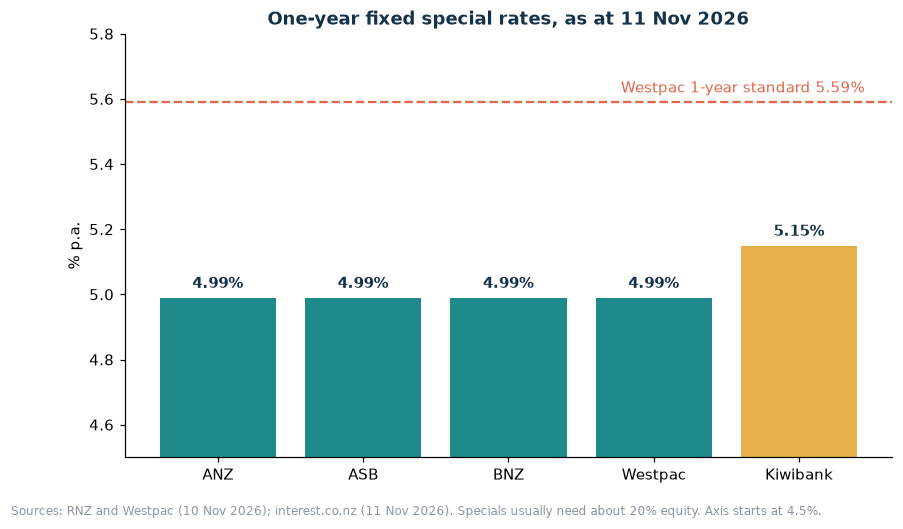
Yes, you can ask, and it’s normal. Banks don’t publish what they’ll do to keep you, and retention cash is “highly unlikely” to be offered automatically when your fixed rate ends (Threefold). Before you accept the rollover offer: 1) check you’re on the bank’s special rate, not its standard rate; 2) get a written offer from at least one other lender, or have a mortgage adviser working under a licensed Financial Advice Provider compare the market; 3) ask your bank to match or beat it on rate and cash; 4) weigh any clawback, break fee and legal costs before you decide to move. As of 11 November 2026, ANZ, ASB, BNZ and Westpac all advertise a 4.99% one-year special (RNZ), so the gap between banks is often in the cash and conditions, not the headline rate.
Checked 13 November 2026.
01Why this matters right now
When your fixed term ends, most banks send a letter, text or app notification asking you to pick a new rate. It’s easy to tap “accept”. The problem is that the offer in the app isn’t always the best one the bank will do.
Mortgage adviser Karen Tatterson told RNZ that online and app refix rates are “often the best rates available, but it was worth checking”, and that where rates aren’t competitive, advisers “go to the bank on their behalf and seek better rates” (RNZ). Another adviser in the same story said he “would always negotiate for the best discount possible”.
Three things make the ask more useful in late 2026:
- The big four are level on one year. Westpac cut its one-year special to 4.99% from 11 November, which brings it in line with ANZ, ASB and BNZ. Kiwibank was still at 5.15% (interest.co.nz). When rates are level, cash and conditions become the difference.
- Rates could move again. The OCR is 2.75%. The next decision is on Wednesday 9 December 2026, and inflation is above the Reserve Bank’s target range (RBNZ). Westpac says its economists “still think interest rates are heading upwards over the next year” (Westpac).
- Cash comes with strings. If you took cashback in the last few years, check your clawback date before you move. Clawback periods are typically two to four years (Threefold), so asking your current bank to sharpen its offer may be the better first move.
If you’ve wondered “how do I know if I’m not getting a good deal?”, that’s the question this guide answers. It’s one borrowers ask a lot.
02What you can actually ask your bank for
A “better deal” isn’t just the rate. When you ask, think about five things.
| What to ask for | What it looks like | Why it matters |
|---|---|---|
| A sharper rate | Matching another lender’s rate for the same term, or a discount off the advertised special | Every 0.10% on $500,000 is about $500 a year in interest (simple maths) |
| The special rate, not the standard rate | Westpac’s one-year special is 4.99%; its standard one-year rate is 5.59% | A 0.60% gap is about $3,000 a year on $500,000 |
| Retention cash | A one-off payment to stay, usually with a clawback period | Banks rarely offer it unless asked |
| Help with costs | Covering fees on a restructure or top-up | Reduces the cost of staying |
| Better conditions | A shorter clawback period, an offset or split structure, room for lump-sum repayments | Keeps your options open next time |
Rate figures: Westpac media release, 10 November 2026. Dollar figures are simple annual interest on the full balance.
The special-versus-standard gap is the one people miss. Westpac’s release notes that “a low equity margin may apply”, and specials usually need around 20% equity. If you’re under that, you may not qualify for the special at all, so ask what you’re actually being offered.
03Step by step: how to ask your bank to match
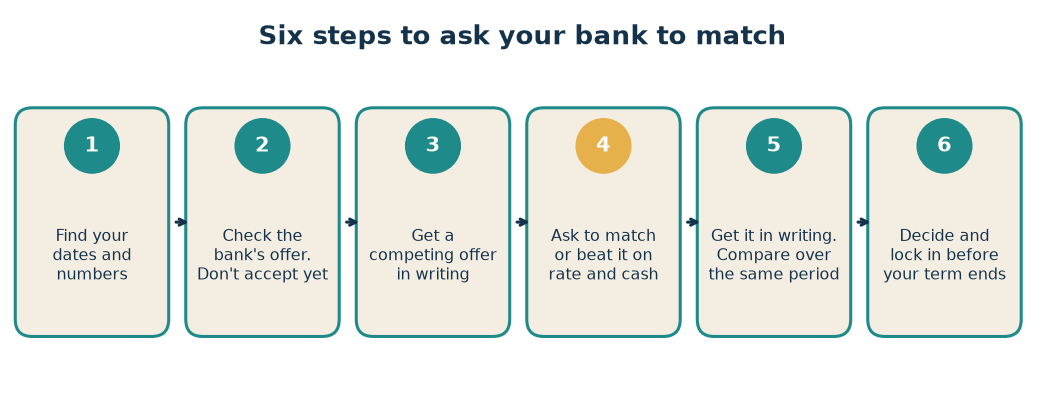
Step 1: Find your dates and your numbers
Before you call, have these ready:
- When each fixed portion ends. If your loan is split, each part may end on a different date.
- Your loan balance and roughly what your home is worth, so you know if you have about 20% equity.
- Any cashback you got, and when. If you’re still inside the clawback period, leaving could mean paying some of it back.
- Your income and debts, in case a new lender needs them.
Step 2: Look at the bank’s offer, but don’t accept it yet
Check the rate in your app or letter against the bank’s own advertised specials. If the app offer is higher than the advertised special for the same term, that’s your first question.
Step 3: Get a competing offer in writing
A real offer is stronger than a screenshot of a rates table. You can get one by applying to another lender, or by asking a mortgage adviser working under a licensed Financial Advice Provider to put your own bank’s retention offer against what other lenders will do.
One borrower described doing exactly that: their own bank “offered a paltry $1500-ish”, while other banks offered “~$6k cash back” (r/PersonalFinanceNZ, via Compare The Mortgage). That’s one account, not an average, but it shows why the second offer matters.
Step 4: Ask clearly
You don’t need a script, but it helps to be specific. Something like:
If you’re talking to a branch or call centre, it’s fine to ask whether your request can go to the lending or retention team. Keep it polite and factual. You’re asking a business for a price, not a favour.
Step 5: Get it in writing, then compare like with like
Ask for the rate, the term, the cash amount, the clawback period and any conditions in writing. Then compare the offers over the same period (for example, three years) and include every cost of moving.
Step 6: Decide, and lock it in on time
If your bank matches, you may be happy to stay. If it doesn’t, moving might still be worth it. Run the numbers in the next section first. Don’t let the deadline pass without choosing: if you don’t choose when a fixed term ends, your loan may move onto the floating rate, which is much higher. ANZ, ASB and BNZ’s floating rates were 6.29% to 6.34% on 11 November 2026 (CorePath, interest.co.nz data).
04Will my bank actually match?
Sometimes, but there’s no rule that says it must. Every offer is at the bank’s discretion, and every cashback and incentive can be withdrawn without notice (Compare The Mortgage).
What borrowers and advisers report:
- Retention cash is usually smaller than switching cash. Threefold says retention payments are “typically” not as much as you’d get for switching banks, but “can still be significant” (Threefold).
- Switch cash is negotiated, not advertised. Advisers who work with Compare The Mortgage put the standard negotiated switch figure at 0.9% of the loan, and up to 1.25% with some lenders (October 2026). Squirrel’s last published range was 0.80% to 0.90% (November 2025) (Compare The Mortgage).
- Asking twice can help. One borrower on r/PersonalFinanceNZ said their bank “offered 0.3% retention bonus” and “came back with 0.49%” after they mentioned an offer from another bank (April 2026 thread). Again, one account.
05Worked examples
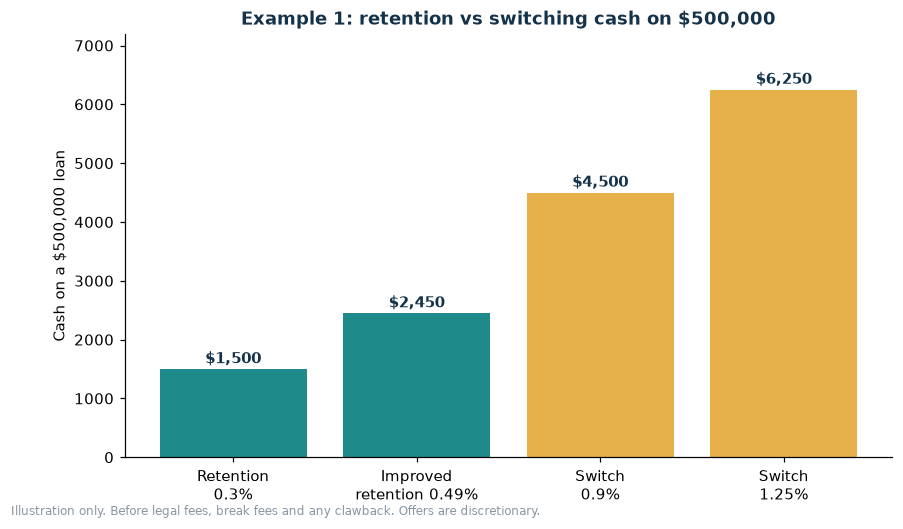
Example 1: Retention cash vs switching cash on $500,000
Say your bank offers 0.3% to stay and, after you show it another offer, lifts that to 0.49%. Another lender offers 0.9%.
| Offer | Cash on $500,000 |
|---|---|
| First retention offer, 0.3% | $1,500 |
| Improved retention offer, 0.49% | $2,450 |
| Switch offer, 0.9% | $4,500 |
| Switch offer at the top of the adviser range, 1.25% | $6,250 |
On the face of it, switching is $2,050 more than the improved retention offer. But you’d need to take off the costs of moving: legal fees (one borrower estimated about $1,000 to $1,500; r/PersonalFinanceNZ), any discharge or valuation fees, any break fee and any clawback on your current cash. Some lenders, such as Kiwibank, advertise help with legal costs for switchers if you meet their criteria, so ask.
Example 2: Why the rate still matters more than the cash
A cashback on a dearer loan can leave you worse off. In MoneyHub’s worked example, a lender paying $3,500 cash charged $178 more a month. Over three years that’s $6,408 extra, so the borrower ended up $2,908 worse off (MoneyHub’s example, via Compare The Mortgage).
So when you compare, put the rate and the cash side by side over the same period. A good match from your own bank on rate, plus some retention cash, can beat a bigger cheque somewhere else.
Example 3: When moving mid-term costs more than it saves
interest.co.nz worked through an example of a borrower (“George”) who fixed $575,000 for two years at 5.74% with a $4,250 cashback, then wanted a cheaper rate. Breaking early meant a $7,457 break fee, plus a possible $3,020 clawback on his cashback ($4,250 × 778/1,095 days) if he left for another bank (interest.co.nz).
The lesson: the cheapest time to ask, or to move, is usually when your fixed term is ending anyway. Break fees depend on wholesale rates and change daily, so get a quote from your bank before you decide.
06When it might make sense to move instead
Staying is simpler, but moving can be worth it when:
- Your bank won’t match, and the other offer is better after all costs.
- You’re outside any clawback period on cash you received before.
- You want a feature your bank doesn’t offer, such as an offset account (Threefold).
- Your fixed terms are ending, so there’s no break fee.
It might not make sense when you’re inside a clawback period, have a big break fee, have less than about 20% equity (you may only get standard rates elsewhere), or your circumstances have changed and a new lender would need to reassess you.
07Should I do it myself or use an adviser?
Plenty of people ask their bank directly and do well. An adviser can help by comparing several lenders at once and asking on your behalf.
If you use one, know how they’re paid. Most mortgage advisers are paid commission by the lender. They must tell you upfront how they’re paid (FMA).
08FAQ
Will my bank match another bank’s mortgage rate?
It might. There’s no obligation, and offers are at the bank’s discretion. You’re more likely to get a useful answer if you have a written offer for the same term and you ask before your fixed rate ends.
Is asking for retention cash greedy?
No. Banks pay cash to win new customers, and retention payments exist to keep existing ones (Threefold). Asking is normal.
Do I have to accept my bank’s rollover offer?
No. You can ask questions, look at other lenders and choose a different term. Just make a decision before the deadline so you don’t roll onto a higher floating rate by default.
Does retention cash have a clawback?
Usually, yes. Most cashbacks and retention payments come with a clawback clause, usually two to four years, and you may have to repay some or all of the cash if you sell or refinance early (Threefold). Check the terms in writing.
What if all the banks have the same rate?
Then compare cash, conditions and costs. As at 11 November 2026, ANZ, ASB, BNZ and Westpac were all at 4.99% for one year (RNZ), but they won’t necessarily offer the same cash or terms.
Should I refix before or after the 9 December OCR decision?
No one can tell you for sure where rates will go. Banks set fixed rates based on where they expect rates to head, not just the OCR on the day (RBNZ). If your term ends around then, ask your bank how early you can lock a rate and whether you can change it before it starts.
09How to use the form
The form is at apply.alfredassistance.com. Most questions are tap-to-choose answers in ranges, not exact figures. The exact questions change with your answers. Here’s what it asks.
- What you’re looking to do. Buy your first home, buy your next home, refix, switch banks, borrow more on your home, or buy an investment property. Pick the one closest to what you want help with.
- Your loan and timing. Whether you already have a mortgage adviser and where the property is. Then, depending on your first answer, things like your timing, roughly how much is left on your mortgage (or how much you’d need to borrow), and who your mortgage is with now.
- You and your finances. Who’ll be on the loan, residency status, household income before tax, how you’re paid, any other debts, and how you’d describe your credit history. The form notes that an honest credit history answer doesn’t affect your credit score.
- Your call. Whether you’re ready to go ahead if the adviser can get it sorted, and what times suit you for a call. There’s also an optional box for anything the adviser should know. Please don’t put account, card or ID numbers in it.
- Your details and a text code. Your first name, last name, email and NZ mobile. You check your answers, tap Text me my code, then type the 6-digit code from the text and tap Confirm and send my enquiry.
What happens after you send it. If we can match your enquiry, it goes to one mortgage adviser in our network, not several, who works under a licensed Financial Advice Provider, and you’ll get a text telling you who it is. They may be based anywhere in New Zealand, not necessarily near you.
It’s free. Alfred never charges you, whether or not we can match your enquiry: adviser firms pay Alfred for introductions. There’s no credit check to enquire.
Start the form →10Sources
All accessed 13 November 2026 (NZDT) unless noted.
- Threefold, Mortgage cashbacks and cash-retention payments
- RNZ, Westpac raises one home loan rate, cuts others
- RNZ, Want cash? A better rate? Banks' 'secret' home loan offers
- interest.co.nz, Westpac changes most fixed home loan rates
- RBNZ, The official cash rate
- Westpac NZ media release, Westpac NZ cuts popular fixed home loan rates
- Compare The Mortgage, Mortgage cashback NZ
- CorePath Financial, rates table from interest.co.nz data, checked 11 Nov 2026
- r/PersonalFinanceNZ, Refinancing after 3 years for the cashback
- Kiwibank, Switch your home loan to Kiwibank
- interest.co.nz, Comparing mortgage offers when break fees are involved
- FMA, Mortgage advice


