
The short answer
Mortgage cashback (banks also call it a cash contribution) is a lump sum a lender pays you when you take out or keep a home loan. In return you agree to stay, usually for three or four years. Leave early and you repay some or all of it. In New Zealand today the big banks advertise cashback mainly to first home buyers. Cash for switching banks is negotiated, and advisers told RNZ it is up to about 0.9% to 1% of the loan. Cash to stay when you refix is usually smaller, often 0.25% to 0.4%, and you normally have to ask for it. Cash is only worth taking if the whole deal, rate included, still stacks up.
Checked 2 November 2026.
01Why cashback is back on people’s minds
Last summer was a cashback scramble. ANZ ran a campaign at the end of 2025 offering cash equal to 1.5% of the loan to new home loan borrowers, and other lenders matched it (RNZ, 24 Mar 2026). In December 2025, a record $5.785 billion of new mortgage lending, 41.1% of the month’s total, was people changing lender (interest.co.nz, 29 Jan 2026).
Many of those borrowers are now inside a clawback period, and many refixers are asking why new customers get the better deal.
The rate outlook adds to it. The Reserve Bank held the Official Cash Rate at 2.75% on 28 October 2026 in a 4–3 vote, and the committee agreed “tighter monetary policy is likely to be required but remains conditional on the economic outlook” (RBNZ). The next decision is on Wednesday 9 December 2026 (RBNZ).
02What mortgage cashback is
Cashback is money a lender pays into your bank account, usually when the loan is drawn down.
The catch is the clawback period. When you accept the cash, you agree to keep your lending with that bank for a set time. Kiwibank explains the trade-off plainly: “the benefit of a cash contribution is spread over the length of the claw back period” (Kiwibank).
The Financial Markets Authority’s advice is to “be wary of short-term incentives such as cashback payments from banks – make sure the long-term fundamentals of the mortgage stack up” (FMA).
03The three kinds of cashback in New Zealand
1. First home buyer offers (advertised)
These are the only cashback deals the big banks publish. On 2 November 2026 their own pages said:
| Bank | Advertised offer | Minimum loan | Stay period / clawback |
|---|---|---|---|
| ANZ | At least $5,000 | $200,000 | At least 3 years |
| ASB | $5,000, even with less than a 20% deposit | $200,000, drawn in full at settlement | Pro-rata if you leave within 36 months |
| BNZ | At least $5,000, deposits from 5% | $250,000 | 100% repayable in year 1, 66% in year 2, 33% in year 3 |
| Kiwibank | At least $5,000 | $250,000 | 4 years, reducing daily |
| Westpac | $5,000 or more; needs 20% equity and salary credited to Westpac | $250,000 | Not stated on the offer page; check your loan agreement |
Sources: ANZ, ASB, BNZ, Kiwibank, Westpac. Each bank decides who counts as a first home buyer, and lending criteria apply.
2. Cash for switching banks (negotiated)
No main bank advertises a switching cashback right now. It is offered case by case. Jeremy Andrews of Key Mortgages told RNZ that new or refinanced lending was getting “up to 0.9 percent or even 1 percent cashback” (RNZ).
Some campaigns come and go. The Co-operative Bank offered 1% cashback, up to $15,000, to its existing customers refinancing an owner-occupied home loan from another provider, but only for loans drawn down between 10 March and 31 August 2026 (The Co-operative Bank). That window has closed.
3. Cash to stay when you refix (retention)
Banks also pay some customers to stay. Mortgage adviser Helen Stuart told RNZ it was common for retention payments to be about 0.4% of the loan, “but it varies”. Andrews put retention cash at “often between 0.25 percent to 0.4 percent of the lending amount” (RNZ).
ANZ told RNZ that “our bankers can sometimes offer cash contributions to existing customers”. It is rarely offered automatically. One adviser firm puts it this way: you’ll most likely just get a message that your fixed rate is expiring (Threefold).
04Can I get cashback when I refix my mortgage?
Sometimes, if you ask. Advisers quoted by RNZ described what tends to help and what tends to get a no.
When retention cash is more likely
- All your lending is coming off its fixed term at once. Stuart said retention payments were showing up “especially when someone had all their lending come off a fixed term”.
- You’ve had the loan a while and haven’t had cash recently. Andrews said it depends on how long you’ve had the loan, whether you’ve taken a cashback before, and whether you have more than 20% equity.
When it’s less likely
- Part of your loan is still fixed. Stuart had one client turned down “who still had a year to run on half his lending”, because moving would have meant a break fee.
- Moving wouldn’t really pay you. Andrews said some banks refuse when switching would cost you in break fees or higher rates, or when legal costs would exceed the cash.
How to ask
- Start about 60 days before your fixed term ends. Several banks let you lock in a new rate from then.
- Ask your bank, in writing, for its best rate and any cash contribution for staying.
- Get at least one written offer from another lender, so you know what moving is really worth.
- Ask each lender for the clawback period, how it reduces, and what triggers it.
- Compare the whole package, not the cash alone (see the worked examples below).
05How clawbacks work, and why the method matters
The rules are getting fairer
In 2024 the Commerce Commission recommended that home loan providers “pro-rate all clawbacks for mortgage adviser commissions and bank cash contributions”. In its September 2025 progress report it said most banks had made some progress, and that ANZ had implemented the change in full (Commerce Commission).
Three ways banks work it out
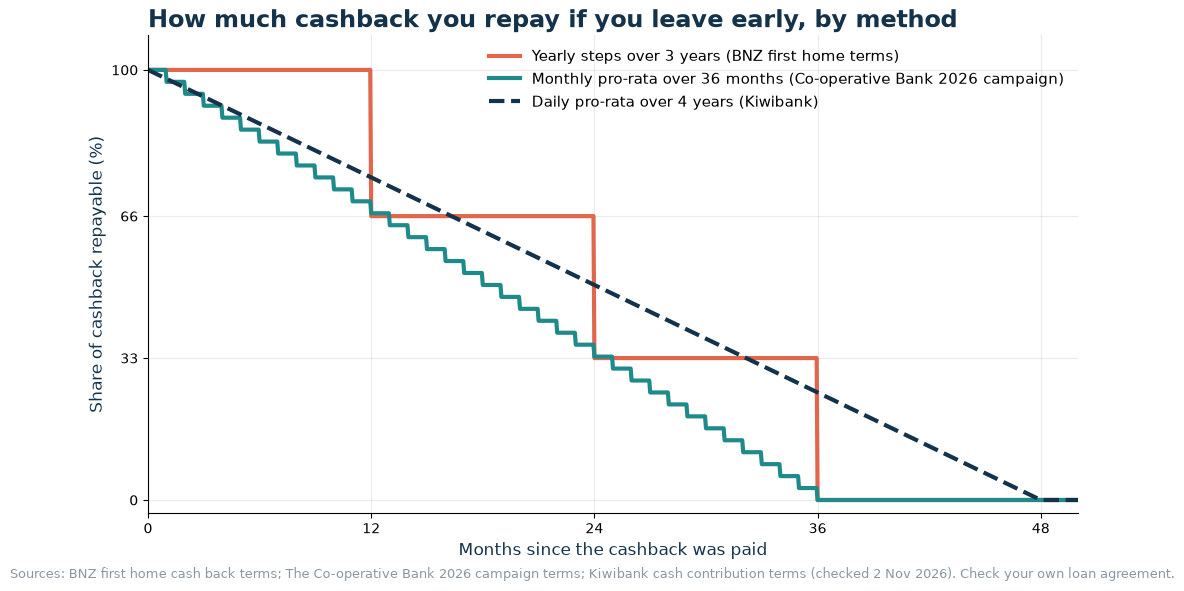
- Yearly steps. BNZ’s first home offer: leave within a year and you repay 100%, in year two 66%, in year three 33%, then nothing (BNZ).
- Monthly pro-rata. The Co-operative Bank’s 2026 campaign reduced the amount each month over 36 months. Its own example: refinance after 12 months and you repay two-thirds (The Co-operative Bank). ASB’s first home terms say a “pro-rata portion” is repayable within 36 months, “as determined by ASB”.
- Daily pro-rata. Kiwibank divides the cash by 1,460 days. Its example: on $4,000, the daily rate is $2.74, so if you had to repay 650 days later you would owe $2,219 (Kiwibank).
What can trigger a clawback
It isn’t only switching banks. Depending on the lender, it can be:
- refinancing to another lender
- repaying the loan, including when you sell (ASB and BNZ both name a mortgagee sale)
- for Kiwibank, a significant change in your “banking relationship”, such as no longer having your income paid into a Kiwibank account.
Don’t mix it up with an adviser clawback
If an adviser arranged your loan and you move it within a set time, the lender may take back the adviser’s commission. The adviser may then charge you a fee, but only if they told you about it upfront. The FMA notes these are different from cashback clawbacks, and you could be charged both (FMA).
06Worked examples
Example 1: Cash to stay vs cash to move
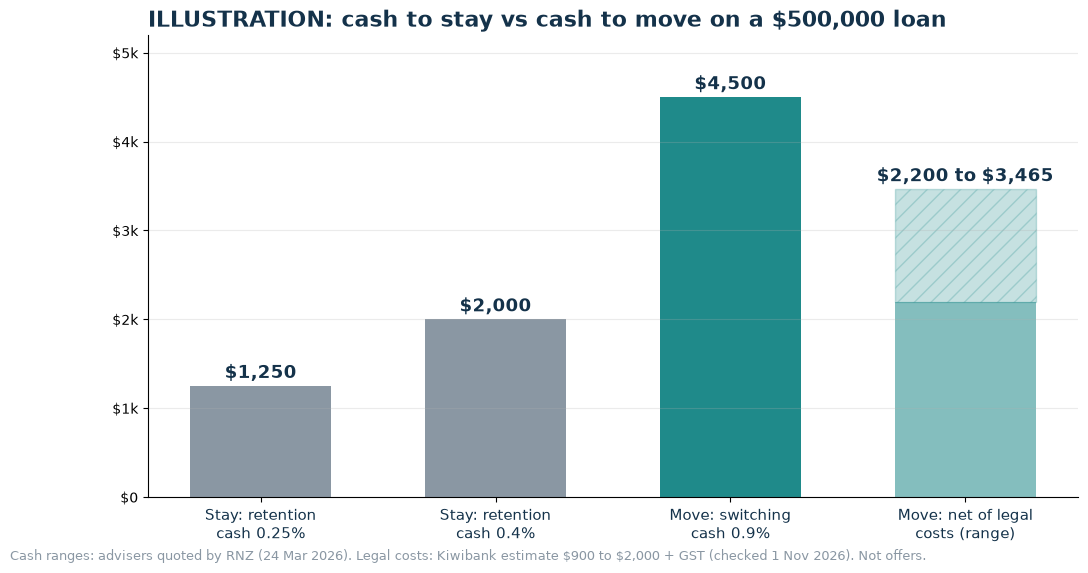
- Retention cash at 0.25% to 0.4%: $1,250 to $2,000.
- Switching cash at 0.9%: $4,500.
- Legal costs to move: Kiwibank estimates $900 to $2,000 plus GST and disbursements, which is about $1,035 to $2,300 with GST (Kiwibank, checked 1 Nov 2026).
- Net switching cash after legal costs: about $2,200 to $3,465.
Moving is ahead, but by less than the headline suggests. Adviser Campbell Hastie told RNZ he arranged more retention payments than refinances, because once legal fees were paid “the retention cash payment looked about the same as the refinance cash less legal fees, not to mention the effort required” (RNZ).
Some banks cover legal costs for eligible switchers. BNZ says its Home Loan Switch “could save you up to $2,500” (BNZ, checked 1 Nov 2026). That changes the maths, so ask.
Example 2: Cash, or a lower rate?
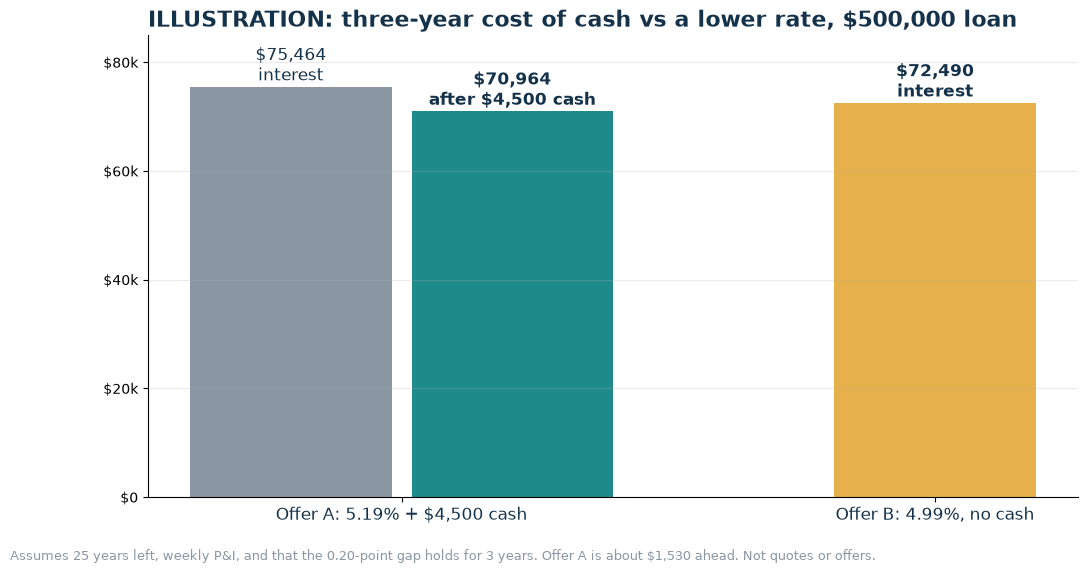
Both offers on $500,000 with 25 years left, repaid weekly.
- Offer A: 5.19% plus $4,500 cash. Weekly repayment about $687. Interest over three years about $75,460.
- Offer B: 4.99%, no cash. Weekly repayment about $673. Interest over three years about $72,490.
Offer B saves about $2,970 of interest over three years, but Offer A’s $4,500 cash more than covers that. Offer A is about $1,530 ahead, if the 0.20-point gap held for all three years.
A useful rule of thumb: on $500,000, each 0.10 of a percentage point is worth roughly $500 of interest a year. Spread over a three-year clawback, $4,500 of cash is worth about 0.30 points a year.
The caveat: most people fix for one or two years, so the gap rarely holds for three. The NZ Banking Association’s home loan comparison calculator on interest.co.nz turns cash, fees and clawbacks into an effective rate for up to three offers, which makes this comparison much easier (Commerce Commission).
Example 3: Leaving early
Say you received $5,000 and leave after 20 months (about 608 days). Using each method above:
- Yearly steps (BNZ first home style): 66% repayable, so $3,300.
- Monthly pro-rata over 36 months: 16 of 36 months left, so about $2,222.
- Daily pro-rata over four years (Kiwibank style): 852 of 1,460 days left, so about $2,918.
Same cash, same date, three different bills. That is why the method matters as much as the headline amount.
Example 4: What to do with the cash
At 5.19%, paying a $5,000 cashback straight off a $500,000 loan with 25 years left and keeping repayments the same would save roughly $13,000 of interest over the life of the loan and finish it about half a year sooner, if that rate held throughout. Using it for legal or moving costs is also a reasonable choice.
07Cashback and tax for property investors
If the loan is for your own home, Inland Revenue’s draft guidance says the cash “will not be income of the borrower and will not give rise to any income tax obligations”.
For a rental property loan it’s different. The draft says the cash is not taxed when you get it. Instead it goes into a “base price adjustment” in the final year of the loan, where it is offset against that year’s deductible interest. IRD’s example: a $10,000 cashback with $7,000 of interest paid in the final year gives $3,000 of taxable income (IRD, PUB00504).
This is draft guidance (consultation closed 3 September 2026), and mixed-use or repaid cashbacks can work differently.
08Before you take the cash: a checklist
- Get the offer in writing. Amount, clawback period, how it reduces, and what triggers it.
- Check your current clawback. If you took cash in the last three or four years, find out what you’d owe if you moved.
- Check the conditions. Salary crediting, minimum equity, minimum loan size and fixed-term rules all vary.
- Compare effective rates. Use the NZBA calculator to weigh cash against rate.
- Count all the costs of moving. Legal fees, discharge fees and any break fee.
- Diary the clawback end date. That is your next real negotiating window.
09Where a mortgage adviser fits
You can ask lenders yourself. An adviser can help when you want several lenders compared at once, with the cash, clawback, break fee and legal costs added up. The FMA says most advisers are paid commission by the lender and must tell you upfront how they’re paid (FMA).
10Frequently asked questions
How much cashback can I get when I refix my mortgage?
There is no published figure. Advisers told RNZ retention cash is often 0.25% to 0.4% of the loan, which is $1,250 to $2,000 on $500,000. Many borrowers get nothing unless they ask.
Do NZ banks still offer cashback for switching?
Yes, but it is negotiated rather than advertised. Advisers quoted by RNZ in March 2026 put it at up to 0.9% or even 1% for new or refinanced lending. Each offer depends on your loan, equity and history.
Will I have to pay back my cashback if I refinance or sell?
If you leave within the clawback period, usually three or four years, you’ll repay some or all of it. How much depends on the lender’s method. Selling and repaying the loan can count as leaving.
Is mortgage cashback taxable in NZ?
Not for a loan on your own home, according to IRD’s draft guidance. For a rental property loan, the cash is taken into account when the loan ends.
Can I get cashback with less than a 20% deposit?
Some first home offers allow it. ASB’s applies even with less than a 20% deposit, and BNZ’s from a 5% deposit. Westpac’s needs 20% equity. Lending criteria still apply.
When is the next OCR announcement?
Wednesday 9 December 2026 at 2pm.
11How to use the form
The form is at apply.alfredassistance.com. Most questions are tap-to-choose answers in ranges, not exact figures. The exact questions change with your answers. Here’s what it asks.
- What you’re looking to do. Buy your first home, buy your next home, refix, switch banks, borrow more on your home, or buy an investment property. Pick the one closest to what you want help with.
- Your loan and timing. Whether you already have a mortgage adviser and where the property is. Then, depending on your first answer, things like your timing, roughly how much is left on your mortgage (or how much you’d need to borrow), and who your mortgage is with now.
- You and your finances. Who’ll be on the loan, residency status, household income before tax, how you’re paid, any other debts, and how you’d describe your credit history. The form notes that an honest credit history answer doesn’t affect your credit score.
- Your call. Whether you’re ready to go ahead if the adviser can get it sorted, and what times suit you for a call. There’s also an optional box for anything the adviser should know. Please don’t put account, card or ID numbers in it.
- Your details and a text code. Your first name, last name, email and NZ mobile. You check your answers, tap Text me my code, then type the 6-digit code from the text and tap Confirm and send my enquiry.
What happens after you send it. If we can match your enquiry, it goes to one mortgage adviser in our network, not several, who works under a licensed Financial Advice Provider, and you’ll get a text telling you who it is. They may be based anywhere in New Zealand, not necessarily near you.
It’s free. Alfred never charges you, whether or not we can match your enquiry: adviser firms pay Alfred for introductions. There’s no credit check to enquire.
Start the form →12Sources
All accessed 2 November 2026 (NZDT) unless noted.
- RNZ, Banks are paying customers to stay (24 Mar 2026)
- interest.co.nz, Bank switching surges to $5.8b in December (29 Jan 2026)
- RBNZ, OCR held at 2.75% (28 Oct 2026)
- RBNZ, MPS and OCR December 2026 (9 Dec, 2pm)
- Kiwibank, Rates & fees (clawback explanation; legal estimate $900–$2,000 + GST, checked 1 Nov 2026)
- FMA, Mortgage advice (cashback warning; commission; clawback fee disclosure)
- ANZ, Buying your first home (at least $5,000 on $200k+, stay 3 years)
- ASB, First Home Loan page incl. First Home Buyer Cash Contribution terms ($5,000, $200k drawn in full, pro-rata within 36 months "as determined by ASB", mortgagee sale)
- BNZ, Cash back home loan offer (min $5,000, $250k+, deposit from 5%, 100/66/33% table)
- Kiwibank, Cash contribution (FHB offer; 4-year daily pro-rata; $4,000 / 650 days = $2,219 example; banking relationship)
- Westpac, Buying your first home ($5,000 or more on $250k+; 20% equity and salary credit)
- The Co-operative Bank, 2026 Existing Home Loan campaign T&Cs (1% up to $15,000; drawn 10 Mar–31 Aug 2026; 36-month monthly pro-rata; 12-month example)
- Threefold, Mortgage cashbacks and cash-retention payments
- Commerce Commission, 12-month report to Ministers (19 Sep 2025; Recs 10 and 11; NZBA calculator)
- Westpac media release, 30 Oct 2026 (1-year special 5.19%, effective 2 Nov 2026)
- BNZ, Switch your home loan to BNZ ("could save you up to $2,500", checked 1 Nov 2026)
- NZBA / interest.co.nz Home loan comparison calculator
- IRD, PUB00504 Income tax


